April 4: Listen to one of the country's major experts on global climate change
January 31: Find out what is causing global climate change, and what can be done
When: Wednesday January 31, 7:00 PM
Where: Church of the Saviour, 6205 Rucker Road Indianapolis
How much are human practices contributing to substantial and irreversible changes to the environment? What effect are changes to the climate having in different areas of the planet? What response can the international community adopt to lessen the impact of dramatic climate change?


If this event sounds interesting, you should check out All Gore when he comes to town in April, or just get a copy of "Inconvenient Truth." Even better will be to join in other discussions of climate change and the environment. As part of the ICWA's Great Decisions series, you can hear IUPUI climatologist Gabriel Filippelli February 6. Stanford scientist Stephen Schneider discusses "Can we measure, let alone solve, global warming" April 18.
Return to IndyBuzz List of Events for Spring
Return to IndyBuzz Themes for Events in the Spring
February 6: Discuss the science and politics of global climate change
Prof. Gabriel Filippelli--Chair Department of Earth Sciences at IUPUI and Associate Director of Center For Environmental Health at Indiana University -- discusses global climate change for the Great Decisions Series of the Indiana Council on World Affairs.
When: Tuesday, March 29 7:00-9:00 PM
Where: Butler University, Pharmacy Building
How much are human practices contributing to substantial and irreversible changes to the environment? What effect are changes to the climate having in different areas of the planet? What response can the international community adopt to lessen the impact of dramatic climate change?
These and other questions will be addressed by Prof. Gabriel Filippelli of IUPUI. Part of the reason why the public and policymakers seem confused about the topic of "global warming" (perhaps more precise would be to call the topic "massive human induced climate change") is that the science is hard. It isn't just that the math underlying the models is beyond our brains, there is also a matter of understanding the nature of the scientific method and the role of doubt.
Filippelli should be a valuable guide, a real live honest to goodness climate scientist who works hard to clarify issues for ordinary citizens. Here's how he describes his research agenda. Filippelli was featured in a WISH-TV feature about global climate change.
“When greenhouse gases like carbon dioxide and methane go up in our
atmosphere, because of physics, the atmosphere and the planet simply have to warm,” said Dr. Gabriel Filippelli, IUPUI. Proponents say they have proof. “We can prove this by doing this in a lab experiment in a beaker. You add more of these gases in, the beaker is going to be hotter with the same amount of incident light,” said Filippelli.
The only way to predict future climate is through computer models. “Weather models have a hard time forecasting weather conditions past a week or 10 days,” said Randy Ollis, Forecast 8 meteorologist. Researchers say climate models are
different. “The science behind understanding climate change is much more solid than it was even 10 years ago,” said Filippelli. “Climate models are extremely stripped down and they just deal with some basic aspects of atmospheric physics,” said Dr. Gabriel Filippelli, IUPUI. They’re basic in form, but complex in results. The models don't agree on future climate, but global warming proponents say, “Everyone that I have seen applied projects a warming,” said Filippelli. With that, Filippelli is comfortable enough to say, “If you are looking to buy real estate, Antarctica is I think a good deal right now.”
Prof. Filippelli will surely help connect this global issue to local concerns. We get a taste of this in a news article from last year.
If this event sounds interesting, you should check out the Church of the Saviour's Great Decision discussion of global climate change January 31. And hear a Stanford scientist ask whether we can even measure global climate change on April 18. That makes science sem pretty fuzzy ... so let's listen to the leading authority on the fuzziest of warped and bizarre science on March 7.
Return to IndyBuzz List of Events for Spring
Return to IndyBuzz Themes for Events in the Spring
February 8: Learn about what international public health was like before the World Health Organization
Theodore Brown, the country's leading historian of public health, helps us better understand the challenges of global public health in the 21st century by taking us back half a century
When: Thursday February 8, 4:00-5:00 PM
Where: IU Medical School Medical Science Library, Room IB 301 & 302
Theodore M. Brown, Professor in the Departments of History and of Community and Preventive Medicine at the University of Rochester, will talk about “International Public Health: Before the World Health Organization.” The History of the WHO cannot be fully understood without appreciating the often tangled background of international public health that existed in the years before the Second World War. When WHO came into being, it inherited a legacy that included many tensions, contests over organizational territory, and conflicts over priorities. This presentation will evaluate the key developments in international health in the period leading up to the chartering of WHO, and will pay particular attention to the Office Internationale d'Hygiene Publique and the League of Nations Health Organization.
First, that international public health efforts are deeply influenced and critically shaped by their political context. Programs cannot be created in a vacuum or applied in isolation. They are of this world and, like it, they constantly change and thus need to be frequently renegotiated. Second, the culture of international health organizations must be acknowledged in order to understand what priorities will emerge at any particular time and which will survive intra- and interagency competition. Programmatic ideas are always contested and rise and fall with shifting political alliances.
Third, ideas are applied in a world governed by administrative and bureaucratic realities. The translation of plans into actual programs requires a great deal of persistence and negotiating skill to make them real and keep them functioning. Fourth, international health initiatives must reckon with deep-seated historical and cultural traditions, local realities, and global forces. All play roles in the success and failure of public health activities, and no success is likely to last forever, especially when the world changes in dramatic ways. Fifth, top-down initiatives cannot expect to succeed without real bottom-up support. Because people at the local level understand how programs need to function to address their particular needs, there can be no simple formula for international public health success. A single agenda or set of priorities cannot suit all circumstances.
Clearly, there is an important role for history in global public health. Studying history carefully and generalizing from its particulars may not necessarily help us avoid repeating the mistakes of the past, but by distilling the lessons of history, we can certainly learn more clearly where we have been and, as a consequence, become more aware of where we are.
Return to IndyBuzz List of Events for Spring
Return to IndyBuzz Themes for Events in the Spring
March 7: Travel down "Warped Passages" with Lisa Randall
When: Wednesday, March 7th, 7:30 PM
Where: Butler University Clowes Hall
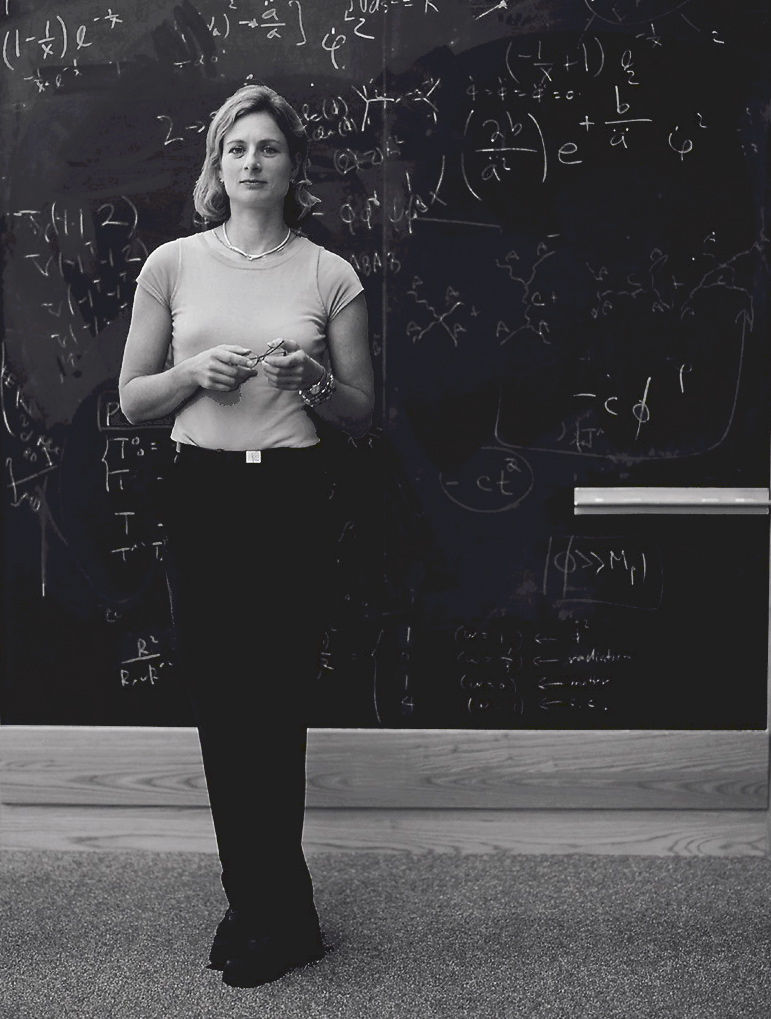
Lisa Randall, Professor of Physics at Harvard University will speak about her book, Warped Passages: Unraveling the Mysteries of the Universe's Hidden Dimensions. The book takes up the topics of particle physics, string theory, brane worlds, and extra dimensions in a way that is accessible and entertaining for a general audience.

Dr. Randall was the first tenured woman in physics at Princeton; the first tenured woman theorist in science at Harvard and at MIT. She's the most cited theoretical physicist in the world in the last five years. She is most known for two papers: "A Large mass Hierarchy From a Small Extra Dimension"; and and "An Alternative to Compactification." Both concern "Warped Geometry/Spacetime" and show that infinite extra dimension and weakness of gravity can be explained with an extra dimension.
Lisa Randall’s research in theoretical high energy physics is primarily related to the question of what is the physics underlying the standard model of particle physics. This has involved studies of strongly interacting theories, supersymmetry, and most recently, extra dimensions of space. In this latter work, she investigates "warped" geometries. The study of further implica
tions of this work has involved string theory, holography, and cosmology. Lisa Randall also continues to work on supersymmetry and other beyond-the-standard-model physics.Within a year of her work on extra dimensions, it was featured on the front page of the Science Times section of The New York Times. It has also been featured in the Economist, the New Scientist, Science, Nature, The Los Angeles Times, The Dallas Daily News, a BBC Horizons television program, BBC radio, and other news sources. She has also been also been interviewed because Science Watch and the ISI Essential Science Indicators have indicated her research as some of the best cited in all of science.
Return to IndyBuzz List of Events for Spring
Return to IndyBuzz Themes for Events in the Spring
April 18: Ask “Can we define, let alone solve, global warming?”
Butler University Woods Lecture Series
Stephen Schneider: “Can we define, let alone solve, global warming?”
7:30pm
Butler University, Atherton Union Reilly Room
Stephen Schneider is Professor for Interdisciplinary Environmental Studies and Professor of Biological Sciences at Stanford University. Dr. Schneider has written extensively on climate change, both science and policy, and will be addressing the question:
Can we define, let alone solve, global warming?
Welcome to IndyBuzz
Visit IndyBuzz's sister site, http://www.provocate.org/, which provides a context for the clusters of the events discussed in IndyBuzz.
Groups that keep Indy Buzzing
- Ambassadors for Children
- American Values Alliance
- Arts Council of Indianapolis
- Big Car Gallery
- Butler University
- Center for Faith and Vocation
- Center on Philanthropy
- Central Indiana Community Foundation
- Christian Theological Seminary
- Clowes Memorial Hall
- Cultural Tourism Initiative
- Franciscan Center for Global Studies
- GeoPol
- Indiana Council on World Affairs
- Indiana Film Society
- Indiana Historical Society
- Indianapolis - Marian County Public Library
- Indianapolis Early Music Festival
- Indianapolis International Film Festival
- Indianapolis Jazz Fest
- Indianapolis Monthly
- Indianapolis Museum of Art
- Indianapolis Opera
- Indianapolis Star
- Indianapolis Symphony Orchestra
- Indianapolis Theatre Fringe Festival
- Indy Ethnic Food
- Intake Weekly
- International Center of Indianapolis
- International Festival
- International Interfaith Initiative
- International Violin Competition of Indianapolis
- IU Kenya Partnership
- IUPUI
- Kiwanis International
- Madam Walker Theatre Center
- Marian College
- Nationalities Council of Indiana
- NUVO
- POLIS Center
- Rotary Club of Indianapolis
- Sagamore Institute for Policy Research
- Spirit and Place
- University of Indianapolis
- World Trade Club of Indiana
Themes linking IndyBuzz events
- Africa
- Africans in the Americas
- art
- Big Car
- Butler University
- children and their vulnerabilities
- China
- crossing borders
- Cuba
- democracy and its discontents
- disoriented American empire
- Eiteljorg
- ending poverty
- environment
- Europe
- faith and religion
- film
- Franciscan Center for Global Studies
- global economy
- Great Decisions
- Hoosier history
- IMA
- Indiana Committee on Foreign Relations
- Indiana Council on World Affairs
- Indiana Historical Society
- Indiana's business
- IU-Moi
- IUPUI
- Japan
- Latin America
- Latinos and Latinas
- law and justice
- Madame Walker Theatre
- Marian College
- Mexico
- Middle East
- morality and civic life
- music and motion
- news media
- popular culture
- prose poetry and plays
- public health
- race and ethnicity
- Rotary
- science and society
- war and rumors of war
- women
- World Trade Club
Archive of Buzzes gone by
- November 2018 (1)
- November 2009 (12)
- February 2009 (58)
- May 2007 (1)
- March 2007 (2)
- February 2007 (7)
- January 2007 (5)
- December 2006 (93)
- August 2006 (31)
- June 2006 (2)
- March 2006 (14)
- January 2006 (73)
- November 2005 (4)
- October 2005 (24)
- September 2005 (92)
- June 2005 (1)
- May 2005 (6)
- April 2005 (12)
- March 2005 (32)
- November 2004 (15)
Directions to get you where things are Buzzing
- Being there at Butler University
- Drive to Big Car Gallery
- Find your way around IUPUI
- Get around the Indianapolis Museum of Art
- How to visit the Indiana Historical Society
- Make it to Christian Theological Seminary
- Move it to Marian College
- Parking around Clowes Hall
- Trek south to University of Indianapolis
Who is IndyBuzz?
- John Clark
- Provocate strengthens the intellectual and civic fabric of Central Indiana by connecting global & local, entertainment & education, culture & policy