A lot of excellent events if you are in Bloomington between February 1st and 10th:
Annual Middle Eastern Arts FestivalContact: Department of Near Eastern Languages and Cultures, Middle Eastern and Islamic Studies Program102 Goodbody, 3rd St, Bloomington, IN 47404, 812-855-5993, Melissa Henige at
nelcmesp@indiana.eduThe Annual Middle Eastern Arts Festival Feb 1st-10th celebrates Middle Eastern art, culture, and influence. Visit the event website at
www.indiana.edu/~nelcmesp/arts for descriptions, dates, locations, etc. This year, theFestival will feature Middle Eastern art and ethnomusicology, art demonstrations, films, food tasting, folkdance, poetry, lectures, and much more. The sponsored events are free and open to the public.


Windfall Dancers, and Iraqi music group Salaam
When: Feb. 2nd, 3rd, 9th, and 10th at 8:00pm
Where: John Waldron Arts Center,122 S. Walnut St.
http://www.artlives.org/Windfall Dancers use modern dance as a narrative to tell the age-old stories of Arabian Nights. The Iraqi music group,
Salaam, performs with them. This show will be a magical event suitable for the entire family. Non-sponsored NELC event, so tickets cost: $10, $8 students and seniors. Tickets available by calling 812-334-0506, at 1101 N. Dunn St, or online at
http://www.bloomingtonarts.info/*********************************************************************************** Middle Eastern Book Exhibit
When: Feb 1st-18th 9AM-5PM
Where: IU-Fine Arts Library, 2nd floor 1133 E. 7th St,
A selection of Fine Arts Library books and facsimile editions of manuscripts on Middle Eastern arts and culture will be exhibited. Accompanying this exhibition will be a selection of artists' books by Buzz Spector, Chair, Department of Art, Cornell University. Contact
B. J. Kish Irvine, Fine Arts Librarian for more information 812-855-5445. Free
************************************************************************************ Persian Film: "The Twilight"
When: Thursday Feb 1st, 7-9pm
Where: Swain East 140, IUB campus

"
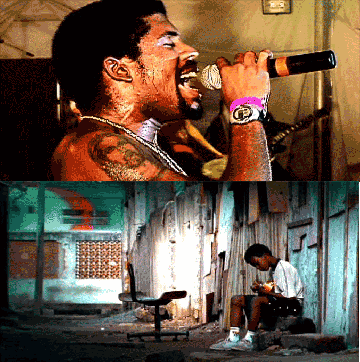
The Twilight", directed by Mohammad Rasoulof, presents an intense and stark portrait of life among the rural underclass and meditates on the meaning of freedom.

In 1998, petty criminal, Reza, who has spent half his life in prison in a northwestern part of Iran marries a woman prisoner. They have a child together and, after a while, the woman is pardoned. Several months later the man is also released. The three of them begin a new life outside the prison, but a harsh society is waiting for them. The director, Mohammad Rasoulof, was born in Shiraz in 1973. He has made numerous short films and has worked as assistant director on feature films. "Twilight" is his first feature film. It is based on true events and the characters play themselves.
Contact:
plosensk@indiana.edu;
sdaneshg@indiana.edu************************************************************************************ Children's Spectacular
When: Sunday Feb 4th, 2-3pm
Where: Monroe Public County Library, 303 E. Kirkwood Ave, Library Auditorium
Children's comic program with folkdance, swordsman, and tales from the Middle East. The program has been designed specifically for children, though enjoyable for any age! Performers
Katya Faris and
Mohamed Shahin will dazzle with their elaborate colorful costumes, dance, and music! Free. For more information call 812-349-3100 or
http://www.monroe.lib.in.us/*********************************************************************************** Middle Eastern Cuisine Sunday
When: Sunday Feb 4th, 7pm
Where: Café Ragazzi,
212 S. Rogers Bloomington Middle Eastern Cuisine Sunday fills up quickly so please call for reservations for International Cuisine Sunday. Graduate student, Ahmad Almallah, and Café Ragazzi owner, Tamyra Dippolito, will present the cuisine and history of Palestine. Call for reservations: 812-323-9005.
************************************************************************************ Internationally known contemporary artist Najjar Abdul Musawwir
When: Monday February 5, 7:00pm
Where: Foster International Center
Najjar Abdul-Musawwir is an award-winning painter, community-arts organizer, educator and consultant. Signatures of Musawwir’s paintings are harmonious visions of contrasting colors, flowing liquidation, and symbolic transparency. He believes the liquidation of the under painting gives balance to the glazing brush strokes in his works. Contact
Andrew Gipe************************************************************************************ Middle East Art related lectures
When: Friday Feb. 9th, 2:30-5:30pm
Where: Lilly Library, 1200 E. 7th St.
Distinguished professors and graduate students of IU-Bloomington--Christiane Gruber, Yasmine Gencer, and Deborah Justice--will provide talks on Middle Eastern art and architecture. Light refreshments will be provided. Free: 812-855-2452,
http://www.indiana.edu/~liblilly/************************************************************************************ Ethnomusicology Career Workshop
When: Feb. 9th, 7-9pm
Where:
Mather's Museum of World Cultures, 416 N. Indiana. St
Irene Markoff, who is well-versed in Sufi music, having written her PhD dissertation on musical theory, performance and the professional baglama(folk lute),and specialist of Turkey. She will give a workshop on "The Challenges of Teaching Turkish Music in an Ensemble/Lecture Setting," as well as strategies and reflections on an ethnomusicology career. Light refreshments provided. Free, call 812-855-6873 for more information. Sponsored by the American Turkish Society.
************************************************************************************ Ethnomusicology Presentation and Performance by Irene Markoff
When: Saturday Feb 10th, 4-6pm
Where: IMU, Faculty Room of the University Club
Irene Markoff will give a talk on Sufi Music and Ritual in Turkey. The presentation will include a discussion on poetry, rituals, music, and the concepts of
sama and
zikr. Performance (baglama and voice) will be integrated into the presentation. Light refreshments provided. Sponsored by the American Turkish Society. For more on this event, see
 One of the country's foremost experts discusses Sufi Music & Ritual in Turkey