Sept. 17: Kick off My Daily Constitution with a public reading at the Statehouse

My Daily Consitution opens on Constitution Day with public “Reading the Constitution” at the Indiana Statehouse

When: Sunday September 17, 2:00-5:30 PM

Where: The Atrium, Indiana State House Building 200 West Washington Street
Ohio Street entrance (North side of Building) Indianapolis
A public reading of the Constitution, with Hoosier Constitutional scholars and lawyers answering your questions live, in real time! Come to read, or listen ... but come with questions and the expectations that you will be starting something special.

For more information ...

Before joining the experts to read and discuss the Constitution, read it on your own. It is surprisingly brief, the shortest constitution of any democracy in the world. As part of “My Daily Constitution,” you can pick up a free copy at several locations around town. There are plenty of copies you can download from the web, including here. If you want to see how much of the constitution has been changed over the years, check out the annotated version provided by Cornell University Law School’s Legal Information Institute. Even more detailed is the Interactive Constitution set up by the National Constitution Center. Take lots of notes and come to Statehouse on Constitution Day ready to ask questions.

Looking for a couple of good background articles about the Constitution? Look at eminent historian Gordon Wood’s “The Founders Rule!,” a review of Bruce Ackerman’s new book, The Failure of the founding Fathers: Jefferson, Marshall, and the Rise of Presidential Democracy. Robert Remini gave a good lecture to the National Endowment for the Humanities in 2003 about “Ordinary Heroes: Founders of Our Republic.”

After discussing the Constitution with some of Indiana’s finest legal scholars, you will probably want to read about this remarkable and still-evolving document. Start with Akhil Reed Amar’s highly acclaimed America’s Constitution: A Biography. Another excellent book is Original Meanings: Politics and Ideas in the Making of the Constitution, by Jack Rakove. Another attempt to discern the original ideas and intentions of the Framers is Novus Ordo Seclorum: The Intellectual Origins of the Constitution, by Forrest McDonald (who visited Indianapolis earlier this year).

There are many websites that collect documents and articles from the Constitution’s history. For two decades, the multi-volume collection The Founders’ Constitution (published by Indianapolis’s own Liberty Fund) was the standard. Now The Founders’ Constitution is available on-line.


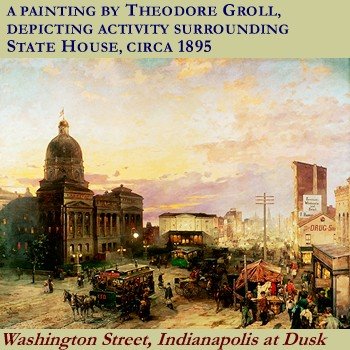
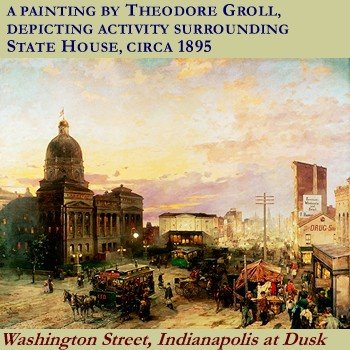
About the venue: The State House that stands at the intersection of Market and Capitol Streets is the third incarnation of a home for Indiana’s legislature. The first State House was built in the 1820s to house state offices and county government, and a second structure was erected in 1835 for just $60,000; however, this building began to deteriorate after only 30 years of use. The current State House was completed in 1888, in a design similar to the U.S. Capitol. Recent renovations have returned the current State House to much of its original state, including the light-filled atriums.
If you like this event ... check out the Arsenal Tech High School Debate team, which will revive the concerns and anxieties about the Constitution that wracked the country more than two centuries ago. You can view a copy of the first running of the Constitution at the Indianapolis Museum of Art, see for yourself what the fuss is all about. And do check out how the hip-hoppin' kids address the issues with the Constitution Poetry Slam.

To return to the IndyBuzz schedule of My Daily Constitution events, click here.

Sept. 18: How free is free speech in academia?

A Constitution Cafe conversation about “What does the 'liberal' in 'liberal arts' mean? The difference between constitutional freedom of speech and academic freedom of speech,” part of My Daily Constitution

When: Monday, September 18, 12:15 PM – 1:00 PM

Where: Democracy Plaza, IUPUI campus breezeway adjacent to University Library

The First Amendment grants a very broad freedom of speech, including the right to proclaim falsities as truth and to denounce those who disagree with us as evil. Within the academic community, slightly different parameters apply. “Liberal” speech is informed by consideration of multiple points of view, and is free speech of a particular sort. It entails both constraints (such as the rules of logic or scientific inquiry), and protections (such as tenure, which prevents a faculty member from being fired because of his/her political views). How can these very different notions of “free speech” be reconciled?

Leading this discussion will be a favorite of civic groups throughout the area, Susan Erickson, a Trustees' Lecturer of Political Science at IUPUI. She teaches courses about the news media and politics, gender and sex roles, and the real and manufactured world of conspiracies. Freedom of speech lies at the heart of many of her courses, which deal with such issues as freedom of the press and the use of speech by militant, extremist, and fringe religious groups.

For more information ... Want some basic background on some of today’s hotly debated questions of freedom of academic speech? Kermit Hall gives a college president’s perspective on “Free speech on public college campuses,” along with helpful background information from the First Amendment Center. Richard Just provides a useful map in “Schools of thought: The liberal-conservative divide on college campuses.” For a Hoosier perspective, check out IU Prof. Robert Ivie’s “Academic Freedom and Political Heresy.”

After the Democracy Plaza event, you’ll want to read a book or two. Free Speech in the College Community by Robert O’Neil is a good place to start, as is Martin Golding’s Free Speech on Campus. For a nice collection of essays from diverse perspectives, check out the volume edited by Peggie Hollingsworth, Unfettered Expression: Freedom in American Intellectual Life.

Susan Erickson credits her understanding of the social forces in America that shape the debate over freedom of academic inquiry and expression to Garry Will’s A Necessary Evil: A History of American Distrust of Government, and to Richard Hofstadter’s classic “The Paranoid Style in American Politics.”

Many groups devote themselves to preserving academic freedom … although they often disagree strongly about the sources of threats to those freedoms. Some, such as Students for Academic Freedom, wave their political agendas proudly. The Foundation for Individual Rights is less shrill. More balanced is the American Association of University Professors, which provides a helpful collection of documents on academic freedom.

About the venue: The Democracy Plaza at Indiana University Purdue University Indianapolis was created with the purpose of providing students, faculty, and staff with an opportunity to express, speak, and hear diverging thoughts surrounding social, political, economic, and religious issues relevant to the campus, city, state, country, and world. The project was started in the summer of 2004 when a group of students, faculty, and staff at IUPUI worked together to address the benefits and drawbacks of a physical structure outside of the traditional walls of academia that would seek to host a common area for students, faculty, and staff across the array of disciplines.

If you like this event ... You should check out some of the other MDC events addressing free speech issues. Art Farnsley comes to the Democracy Plaza the next day to discuss fears that free speech might hurt. Later in the week, learn about today's news media and the First Amendment. And there will be a special discussion of how much protection the speech of kids is given.

To return to the IndyBuzz schedule of My Daily Constitution events, click here.

Return to Navigating IndyBuzz in September

Sept. 18: A discussion of who the heck "We the People" are anyhow?

A Constitution Cafe discussion of "Who are "We the People" Anyway? Personhood, Citizenship and The U.S. Constitution," part of My Daily Constitution

When: Monday September 18, 6:30 PM - 8:30 PM

Where: The Auditorium of the Old Centrum: 1201 North Central Ave. Indianapolis, Indiana 46202

Traditionally we Americans have regarded ourselves as a “nation of immigrants”, and our national identity has not been based on any one specific ethnicity or religion. Instead, the concept of “American” has been grounded in an increasingly inclusive, “civic” identity consistent with the ideal of pluralism. This ideal was not realized even when immigration was largely from European countries; discrimination against Italian, Irish, and Jewish Americans was commonplace. African Americans were excluded from full citizenship for generations. As America becomes demographically more Latino and Asian, and with Islam as the country's fastest growing religion, do we have the will to advocate inclusiveness and pluralism as our national ideal?

Leading this discussion will be local favorites Pierre Atlas (Marian) & Charlie Wiles (Peace & Learning Center). Pierre is an assistant professor of political science and director of the Franciscan Center for Global Studies at Marian College. He writes a bi-weekly opinion column for the Indianapolis Star and a monthly online column for RealClearPolitics.com. Pierre obtained his Ph.D. in political science from Rutgers University in 2000, and also holds Master's and Bachelor's degrees in political science from the University of Arizona and the University of Toronto, respectively. His specialization is Middle East politics and the Arab-Israeli conflict, and he also teaches courses in American politics and U.S. foreign policy.

Charlie Wiles, a true "warrior for peace," holds a degree in Political Science from Indiana University. He spent several years working for the Indiana State Legislature, started a general contracting business renovating older homes, and served as a combat medic in the US Army Reserves from 1991-1999. In 1997 he was founding director of Peace Learning Center, a not-for-profit organization focused on teaching youth nonviolent methods to resolve conflict. Currently he coordinates interfaith/intercultural programs and lives with his wife, Sachiko, and two daughters, Lena and Aya, on the north side of Indianapolis.

For more information ...

Want to learn more about the topic? A good place to start would be the US Citizenship and Immigration Services’ own overview of their history. Nancy Salvato provides another useful historic overview of changing legal notions of citizenship: “Current Issues of Immigration in America.”

A brief overview of some of the changing ideas of citizenship in American history read Rogers Smith’s “The Meaning of American Citizenship.” Smith gives the topic a much more detailed treatment in Civic Ideals: Conflicting Visions of Citizenship in US History. Peter Spiro identifies “The Citizenship Dilemma” at the heart of Smith’s efforts to draw a vision for civic nationalism in America in the 21st century. Noah Pickus offers a thoughtful discussion of these issues in True Faith and Allegiance: Immigration and American Civic Nationalism. Diana Owen, in “Citizenship Identity and Civic Education in America,” explains what this means for education … and not only K-12 education.

Some of the books Charlie Wiles recommends: Words We Live By: Your Annotated Guide to the Constitution, by Linda Monk (or see her video presentation) ; "The Impossibility of Religious Freedom" by Winnifred Fallers Sullivan (read the introduction); and "The Second Bill of Rights: FDR's Unfinished Revolution and Why We Need it Now More than Ever" by Cass Sunstein (or read Sunstein's summary).

Charlie also suggests several websites: Exploring Constitutional Conflicts at www.law.umkc.edu/faculty/projects/ftrials/conlaw/home.html; Centuries of Citizenship at www.constitutioncenter.org/timeline/html/cw13_12363.html; and a glimpse at how others view "We The People" from the Pew Global Attitudes Project at http://pewglobal.org/reports/display.php?PageID=802

Good suggestions from Charlie, check them out.

About the venue: Built as the Central Avenue United Methodist Church in 1892, the facility and its stewards have played a significant role in the social and cultural history of Indianapolis. During the peak of the Social Gospel era in the early 20th Century, the church and its membership battled for child labor laws, developed health care programs for the poor and helped form three enduring institutions: Methodist Hospital, Wheeler Rescue Mission and Goodwill Industries. The church also served as parent to St. Luke's United Methodist Church and played a key role in the development of what is now known as the Old Northside Neighborhood.

If you like this event ...

My Daily Constitution has Constitution Cafes devoted to a couple of groups that are stretching the traditional boundaries of civic inclusion: non-citizens and gay people. Another discussion will focus on the problems African Americans and other groups have had with that most basic of civic rights and responsibilities, voting.

To return to the IndyBuzz schedule of My Daily Constitution events, click here.

Sept. 19: An MDC discussion of the legitimate limits to free speech

Art Farnsley leads a Constitution Cafe discussion about "Hate Speech, Pornography, Prayer before Football Games: What are Legitimate Limits to Free Speech?” at IUPUI's Democracy Plaza, part of My Daily Constitution

When: Tuesday September 19 12:15 PM – 1:00 PM

Where: Democracy Plaza, IUPUI campus breezeway adjacent to University Library

Everyone knows you can't yell "fire" in a crowded theater, but are there other limits to free speech? When does free expression cross the line into doing actual harm to others or excluding them from the political community? Come talk about the hard cases involving hatred, pornography, religious expression, and more.

Leading this discussion will be Art Farnsley, a founding member and executive director of the American Values Alliance, an Indiana-based, grass-roots group committed to civility, fair play, and honesty in the electoral process. His scholarly work illuminates the relationship between religious and political culture. Farnsley has written books on denominational politics in the Southern Baptist Convention, the role of congregations in welfare reform, and religion’s influence on the development of Indianapolis. His current research involves interviewing flea market vendors about their religious and political beliefs.

IndyBuzz featured an excellent speech by Art last year about free speech and American values.

For more information ... about free speech and prayer at public schools’ football games, check out Cathy Young’s “God Talk” (influenced by Jeffrey Rosen’s article, “Is nothing secular?”). James Weinstein has written a well-reviewed book called Hate Speech, Pornography, and the Radical Attack on Free Speech. American Civil Liberties president Nadine Strossen takes on feminists who wish to censor pornography in Defending Pornography: Free Speech, Sex, and the Fight for Women’s Rights. IU professor Jeff Isaac has been a passionate critic of attempts to restrict or criminalize hate speech. Check out his arguments with the group “Bloomington United”: www.bloomington.in.us/~bu/newsarticles.htm.

If you are inspired by the Democracy Plaza discussion of these issues with Art Farnsley, you should check out the local group that Art directs: American Values Alliance. AVA is devoted to preserving civility and fair play in our passion-filled arguments about politics.

About the venue: Democracy Plaza at IUPUI is a large common area for expressing opinions and exchanging ideas in “an atmosphere of fair play,” according to the plaza’s posted guidelines, the space is surrounded by a wall on which faculty, staff, and students scribble questions, ideas, and responses in colorful chalk. Hundreds of people at a time have showed up for outdoor rallies, and more still join in the plaza’s ongoing political expression.

If you like this event ... you should attend Susan Erickson's conversation about academic free speech, and the discussion of the First Amendment and news media.

To return to the IndyBuzz schedule of My Daily Constitution events, click here.

Sept. 19: MDC discussion of whether the USA PATRIOT Act is patriotic (and other security dilemmas)

Claudia Peña Porretti of the ACLU-Indiana leads a Constitution Cafe discussion of what has happened to civil liberties since 9/11 as part of My Daily Constitution

When: Tuesday, September 19 7:00 PM – 9:00 PM

Where: The Athenaeum Foundation: 401 East Michigan Indianapolis 46204

Shortly after 9/11 the U.S. Congress passed the first USA PATRIOT ACT. Fearing further terrorist attacks after 9/11, a large part of the American public supported giving up freedoms in exchange for greater security. Since then the President has claimed that protecting national security requires bypassing Congress and the courts on issues such as domestic surveillance and torture of suspected terrorists. The Framers of the Constitution would not be surprised by these developments. It was why they sought to protect our individual freedoms from fearful majorities by ensuring inalienable rights that the government cannot restrict. It is also why The Framers divided powers among the branches of government so that no one branch could act without being checked by the other branches. How can we tell if the government has gone too far in its search for security, or if it has not gone far enough? What can citizens do to maintain the balance between security and individual rights?

Leading this important discussion will be Claudia Peña Porretti, Executive Director of the American Civil Liberties Union of Indiana. Porretti has worked at Hoosier Veterans Assistance Foundation of Indiana, Inc. (HVAF), where she has served as Director of Development and Communications since 2005. HVAF is a non-profit organization dedicated to eliminating homelessness for veterans and their families. Prior to that, she was Director of Development and Special Events for La Plaza, Inc, a non-profit Hispanic organization that provides programs and services in the areas of health, social services, education, arts and culture, and economic development to the Central Indiana Latino community.

For more information ...

For breaking stories, before going to the Athenaeum check out some recent articles from Google and Yahoo. You should take a look at this piece by Bruce Ackerman about how our legal changes are (and aren't) protecting us "Before the Next Attack," and this article about "What would Dirty Harry Do?" These issues often touch us close to home. The case of the Crazy Tomato "terrorists" in Evansville received national attention here and here).

After the event you may be inspired to seek more informaiton on the web. Start with some of the reports from the US Department of Justice, and contrast them with information from the Electronic Privacy Information Center and the American Library Association. Want a couple of good books? Try David Cole's Enemy Aliens: Double Standards and Constitutional Freedoms in the War on Terrorism and Nancy Chang's Silencing Political Dissent: How Post-September 11 Anti-Terrorism Measures Threaten Our Civil Liberties.

About the venue: The Athenaeum was originally built in the late 1890s to house German societies of Indianapolis, including the Sozialer Turnverein. Das Deutsche Haus (The German House), as it was known prior to World War I, was built in the German Renaissance Revival style and housed a gymnasium, locker rooms, meeting rooms, restaurant, auditorium, bowling alleys, concert hall, and a beer garden. In 1907, it became the home for the Normal College of the North American Gymnastic Union, the country’s oldest institution for physical education training. Although the Normal College eventually merged with Indiana University and moved to IUPUI, today the Athenaeum still houses the city’s oldest restaurant (1894), gymnasium (1894), theater space (1898), and orchestra (1883). Both the Athenaeum Foundation, a nonprofit organization that maintains the building, and the Rathskeller restaurant can be reached at (317) 630-4569.

If you like this event ...

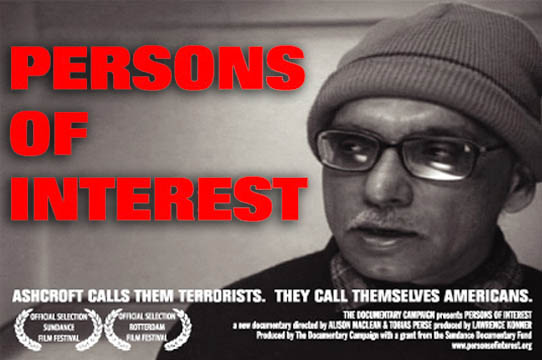
You will definitely want to see Persons of Interest, a documentary about the detention of Muslim-Americans after 9/11, part of the My Daily Constitution Film Festival. Other MDC events address this issue from different angles. While Claudia Peña Porretti will talk mainly about the power of the state being directed at domestic targets, Ed DeLaney looks at the US and international law. Andy Jacobs and I will address another aspect, the constitutional constraints on the President's war-making powers.

To return to the IndyBuzz schedule of My Daily Constitution events, click here.

Return to Navigating IndyBuzz in September

Sept. 20: Ed DeLaney discusses whether US signatures on treaties mean anything

Local/global attorney Ed DeLaney leads a Constitution Cafe discussion on “International Agreements in War Time - Do U.S. Signatures on a Treaty Mean Anything?” at IUPUI's Democracy Plaza, part of My Daily Constitution

When: Wednesday, September 20 12:15 PM – 1:00 PM

Where: Democracy Plaza, IUPUI campus breezeway adjacent to University Library

The War in Iraq and the apparently broader series of events called the War on Terror challenge those Americans who believe in international treaties. Can the President dismiss the relevance of the Geneva Conventions? Will the Congress let him? What will the consequences be in terms of International Law and our chances of conducting a successful foreign policy?

The best person in town, maybe the best people in the country to lead this discussion is Ed DeLaney, one of Indiana’s most experienced trial lawyers. He has handled a wide array of cases for more than 30 years, trying cases throughout the US and in Europe. His principal areas of expertise are business disputes, securities law, estate-related controversies, First Amendment issues, and access to records litigation. DeLaney has also been active in international trade work, especially relating to the former Soviet Union and Eastern Europe. DeLaney has a B.A. and an M.A. in International Relations from the State University of New York at Binghamton. After serving in the United States Navy, he attended the Harvard Law School and graduated with Honors in 1973. At the end of 2003, he retired as a Partner from the firm of Barnes & Thornburg where he had practiced since 1973. In January 2005, Ed joined DeLaney & DeLaney.

What more can be said about Ed? One of the great things about doing a blog like IndyBuzz is the opportunity to plagiarize from myself. Here are some blubs about Ed from previous postings.

Ed DeLaney on the UN:


Ed DeLaney has taught me just about everything worthwhile that I know about the roblems with the UN. He has been on the ground, building new legal systems with he cooperation and obstruction of the UN, and thus brings an utterly refreshing erspective to the question. So here are some questions you should expect Ed to nswer: What should be the role of the UN Security Council? How much should the US bind itself by Security Council resolutions (or lack of resolutions)? What does the N do well, and what does it do poorly? Are Americans correct to worry that nternational law will trump US law, and thus that multilateral organizations such as he UN or the International Criminal Court will supplant the democratically elected overnment of the United States?

Ed DeLaney on Russia:


Ed DeLaney is one of my favorite speakers on Russia. Thanks to a stint in spy school in the 1960s, courtesy of the US Navy, Ed is fluent in Russian. So as Ed rose to prominence as one of the top corporate attorneys in the Midwest and a leader in the Dem party of Indiana, he also carried out extensive business in the USSR. In the 1990s he used his international law experience in the Balkans, representing Bosnia in negotiations and helping establish the legal system in Kosovo. I find his insights on local politics to be most illuminating when he talks about Russia, Central Asia or the Balkans ... I have swiped about a dozen anecdotes and illustrations from Ed that I use in my talks (I hope this lawyer will recognize this as the sincerest form of flattery, not cause for a suit). It will be worth skipping work or cutting class to attend this talk.
Ed DeLaney on international law:


Ed DeLaney is a trial lawyer and currently a partner at DeLaney & DeLaney in Indianapolis. DeLaney has been active in international trade work throughout his career, especially as relates to the former Soviet Union and Eastern Europe. He represented the Federation of Bosnia and Herzegovina in an arbitration hearing under the Dayton Peace Accords. He is an adjunct fellow with the Hudson Institute and an adjunct professor of law at Indiana University–Bloomington. DeLaney has written, in collaboration with John Clark, on the United Nations and how it can be used most effectively to rebuild Iraq.

For more information ...

You should do a bit of reading before the session. Citizens for Global Solutions has a great program on international law and justice. Check out Yahoo for recent articles on the detainess at Guantanamo, one of the clearest points of tension with the Geneva Conventions. For three different perspectives on Ed's discussion, you can read articles from US New & World Report, the National Review, and the American Prospect. And Ed isn't the only local expert on these issues.

After the event you may be looking for more information. Check out the contributions by Marty Lederman on the Balkinization law blog. Human Rights First is an important group. The Lawyers Committee for Human rights has written articulately about this issue: read chapters 4 and 5 of their report A Year of Loss: Reexamining Civil Liberties since September 11, and Behind the Wire: An Update to Ending Secret Detentions.

About the venue: Democracy Plaza at IUPUI is a large common area for expressing opinions and exchanging ideas in “an atmosphere of fair play,” according to the plaza’s posted guidelines, the space is surrounded by a wall on which faculty, staff, and students scribble questions, ideas, and responses in colorful chalk. Hundreds of people at a time have showed up for outdoor rallies, and more still join in the plaza’s ongoing political expression.

If you like this event ...

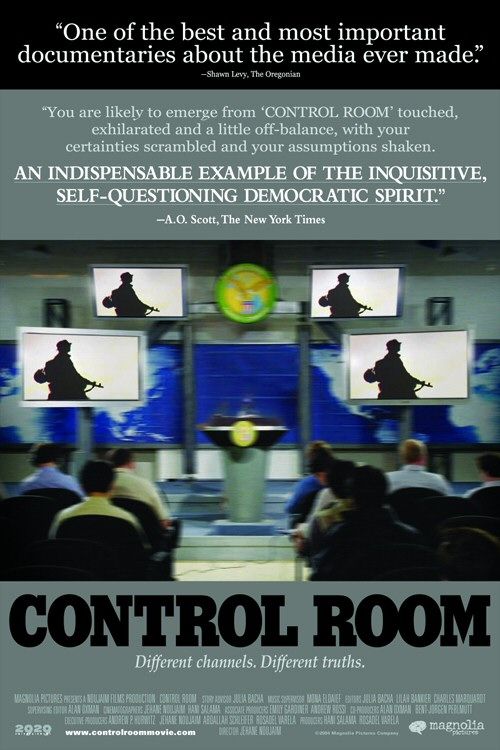
You will love hearing from Andy Jacobs about the Constitution and US foreign policy. You'll also enjoy Claudia Porretti's conversation about the erosion of constitutional protections in the US since 9/11. The movie Control Room, about the Arab TV News network al-Jazeera, shines light on how much of the world sees the US ... it's part of the MDC Film Festival.

To return to the IndyBuzz schedule of My Daily Constitution events, click here.

Sept. 20: Constitution Debate with the award-winning Arsenal Tech High School Constitution Team

The Arsenal Tech High School Constitution Team demonstrates why they have stomped on other constitution debate teams from around the country as part of My Daily Constitution

When: Wednesday Sept. 20 7:00-9:00 PM

Where: The Spades Park Library Auditorium 1801 Nowland Avenue Indianapolis, 46201 317-275-4520

The award-winning Arsenal Tech High School Constitution Team (under the direction of social science teacher Tobi Elmore) will debate the merits of a constitutional government vs. an autocratic or dictatorial government. They will also highlight provisions of the United States Constitution that provide a means of preventing abuse or misuse of government power. What is the relevance of arguments made by the Federalists and the Anti-Federalists to contemporary events under our present government (natural rights, republicanism and constitutionalism)? Two groups of six teens each give reasoned and impassioned statements. Lawyers acting as judges ask them clarifying questions. The evening finale opens the floor for questions from YOU the audience to the teens!

These kids are arguing a great topic. It is easy to forget that many good and patriotic Americans opposed the adoption of the Constitution after it was signed on Constitution Day. You can find several very good books about the Anti-Federalists. Constitutional scholar Bruce Ackerman's latest book has been attracting attention with its arguments that the Constitution was even more flawed than we tend to think: The Failure of the Founding Fathers: Jefferson, Marshall, and the Rise of Presidential Democracy.

Want to learn more about the history of this excellent Constitution debate team? CHeck out Andy Jacob's tribute on the floor of Congress.

About the venue: Spades Park Library is one of two remaining Carnegie libraries in the Indianapolis Marion County Public Library system. The Italian style building was constructed on land donated by Michael H. Spades, and was dedicated in 1912. In 1987 the library underwent renovations and celebrated its 75th anniversary. Bathrooms, new furniture, and an elevator were added, while the original first floor arrangement was maintained, the circulation desk was restored, and part of the original tin ceiling was cleaned and repainted.

If you like this event ... Make sure you attend some of the other lively and off-beat MDC activities such as the Constitution reading and the Hip Hop Constitution Poetry Slam.

To return to the IndyBuzz schedule of My Daily Constitution events, click here.

Sept. 20: Pierre Atlas on “What I did on My Summer Vacation: Reflections on Cuba and Israel”

Pierre Atlas will discuss his recent trips to Israel and Cuba as the lead-off for the Indiana Council on World Affair's Distinguished Speakers series in its new location of The Marten House

When: Wednesday, September 20 Social hour 5:30-6:30; dinner 6:30-7:15; talk 7:15-8:45

Where: The Marten House 1801 West 86th Street Indianapolis 46260 (NOT Butler University)

In May 2006, Pierre Atlas represented Marian College on a 6-day trip to Cuba with members of the Archdiocese of Indianapolis and Catholic Relief Services. The goal of the trip was to deepen the relationship that exists between the Indy Archdiocese and Catholic Charities-Cuba, and in particular with the Archdiocese of Camaguey, and the group spent time in both Camaguey and Havana.

In June, Pierre was one of 22 American academics invited to participate in a two-week workshop on the Arab-Israeli conflict sponsored by Tel Aviv University. The group met with Israeli and Palestinian scholars, journalists and activists and traveled throughout Israel, including up to the Lebanese border where they saw Hizbollah flags flying on the other side. Two weeks after his return to the US, the Lebanon conflict erupted.

At the Marten House (not Butler University!) Pierre will share his experiences from Cuba and Israel, and will offer his analysis of both the current crisis in the Middle East and the potential challenges and opportunities of a post-Fidel Cuba.

Pierre Atlas is an assistant professor of political science and director of the Franciscan Center for Global Studies at Marian College. He also writes a bi-weekly opinion column for the Indianapolis Star and a monthly online column for RealClearPolitics.com.

Did I mention this will be at The Marten House 1801 West 86th Street Indianapolis 46260? Don't go to Butler!

This will be a great talk, you should not miss it. For more information about Pierre's trips, see the Inter/View at the forerunner of "Views -- PR&I," which will be part of the soon to be launched electronic magazine Provocate.

Reservations for this special talk and dinner (at the Marten House!) should be made by calling 317-566-2036, or e-mailing cmatthewfox@gmail.com. E-mail reservations must have the subject heading "ICWA Dinner Reservations" and must contain all contact information, including name, address, telephone, and number of reservations being made. All reservations must be received by the end of the day Thursday Sept. 14. This is also the date by which any cancelations must be received.

Dinner for ICWA members is $22 per person, $24 for non-members. If you would like to attend only the talk, the cost for ICWA members is $3; for nonmembers, the talk alone is $4.

Oh yeah, it is at The Marten House, not Butler.

If you like this event ... Pierre is hosting an important Lebanese expert at Marian College, Akram Khater, on September 14. Khater was on the trip to Israel Pierre will discuss. All three films showing for the "My Daily Constitution" Film Festival are connected to Pierre's talk: Control Room is about the Arab News network Al-Jazeera; Persons of Interest is about Muslims in the US; and Our Brand is Crisis is about the attempted export of American-style political flim-flam to young democracies (perhaps the fate of Cuba soon).

Sept. 21: A discussion of when and why private property should be taken for the public good

A Constitution Café discussion: "Taking private property for public use: When and how should the power of eminent domain be employed?" as part of My Daily Constitution.

When: Thursday, September 21 Noon - 1:00 PM

Where: Shapiro’s Downtown 808 S Meridian St Indianapolis 46225

Historically, there are many examples of governments seizing private property for public use whether to build roads, military bases, hydroelectric plants, or other projects deemed necessary for “the public good”. As the definition of “public good” has broadened to include private redevelopment in communities across the country, the issue of when and how to apply eminent domain has become hotly debated. How can public good be defined in a way that respects individual rights?

A couple of very different and very sharp legal minds will lead this discussion. Abdul-Hakim Shabazz is the host of "Abdul in the Mornings" which can be heard weekday mornings from 5-9 on Newstalk 1430 AM, WXNT. Shabazz’s program focuses on local, state and national issues. His guests have included Governor Mitch Daniels, Mayor Bart Peterson, House Speaker Brian Bosma and Indianapolis City-County Council President Steve Talley. In addition to hosting the morning show, Shabazz is also an attorney, adjunct faculty member at Ivy Tech State College, columnist for the Indianapolis Business Journal and stand-up comedian. Prior to coming to Indianapolis, Shabazz hosted a morning radio talk show in Springfield, IL. Before that he was an assistant to the Illinois Attorney General, and he’s also been a reporter in Central Illinois.

Jeffrey Stake is a professor of law at Indiana University School of Law in Bloomington. He teaches Property, Wills and Trusts, and Land-Use Controls, and has had visiting appointments at Illinois, Colorado, Georgetown, and Paris II (Pantheon-Assas). His research focuses primarily on property law and family law. His interdisciplinary approach brings principles of economics, psychology, and evolution to bear on legal issues from alimony and adverse possession to the Rule against Perpetuities. He is a founding member, and current Vice-President, of the Society for Evolutionary Analysis of Law. At IU, he has received the Leon Wallace Teaching Award and the Trustees Teaching Award.

For more information ...

Looking for reasons to be unhappy about this issue? Ever since the Supreme Court's decision in Kelo v. New London ordered a residents to vacate their homes to make way for a riverfront property development, a lot of people have been unhappy. Try typing "eminent domain" and "theft" into Google, you get nearly a million web pains that share your anger. If you want examples close to home, check out the libertarian Reason Foundation's section on Eminent Domain: several outrages from Indiana (including the Colts and a bean factory). On the other hand, one of the most articulate defenses of eminent domain from the perspective of a policymaker is from Bart Peterson, who argues that the redevelopment of Fall Creek Place would have been impossible without eminent domain (and hurt no one). One of the most insightful scholars of property relations around is Dan Cole, of the IU-Indianapolis law school, who has written a most sensible analysis of Kelo: "Why Kelo Is Not Good News for Local Planners and Developers ."

About the venue. No one in town would accept Shapiro's Deli being the target of eminent domain! Shapiro’s opened its doors to customers in 1905 as a storefront grocery. Louis Shapiro, a Russian immigrant, sold kosher meats and groceries to the southside Jewish community. After prohibition, Shapiro began to sell cold beers, and eventually deli sandwiches, corned beef, and pastrami at the request of customers. The grocery store closed in the late 1930s, but the deli business prospered. Today, the downtown location seats over 200 people, and a second deli opened in Carmel in 2002.

If you like this event ... You really ought to attend the discussion of environmental regulation (and the bus tour). Many of the people who see the abuse of eminent domain as a constitutional outrage are not very friendly toward regulation, which they often call a version of "taking" of property. Should make for an interesting discussion when these two groups attend each other's event.

To return to the IndyBuzz schedule of My Daily Constitution events, click here.

Sept. 21: Andy Jacobs discusses "The War Powers Clause and the U.S. Constitution Today"

Constitution Café: "The War Powers Clause (Article 1, Section 8, Clause 11), and the U.S. Constitution Today" -- Andy Jacobs shares the wisdom and experience of half century of political experience to make sense of whether the Constitution is or should be relevant to the wars we are fighting today ... part of My Daily Constitution.

When: Thursday September 21: 7:00 - 9:00 PM

Where: The Indiana Historical Society 450 West Ohio St. Indianapolis 46202

John Clark chats with Andy Jacobs. Andy is a retired United States Congressman who served fifteen terms representing the 10th District of Indiana. While in office, Jacobs helped write the 1965 Voting Rights Act, led the House of Representatives' all-night debate on the Vietnam War in 1969, and served on the Ways and Means Committee. Jacobs received a B.A. and a J.D. from Indiana University. Prior to serving in Washington, Andy worked as a Marion County police officer, served as a Marine in the Korean War, and was elected to the Indiana General Assembly in 1958. His most recent book is 1600 Killers: A Wake-Up Call for Congress (New Iraq Edition), published in 2006. For a very good short bio of Andy, check out Nuvo's Cultural Visions Lifetime Achievement Award.

Of all of the fun events scheduled for My Daily Constitution, this one may be the most fun of all. IndyBuzz's take on the topic (which may be a bit gaudier than the official description):
The Constitution gives to Congress the exclusive right to declare war,
while designating the President commander-in-chief of the military. How
realistic is this division of power? In the country's history, Congress has
declared war just five times (most recently in World War II), while the
President has deployed troops outside the US more than 200 times. And can we
afford to be constrained by a Constitution written two centuries ago, before
globalization connected caves in Afghanistan to skyscrapers in New York, before
our enemies dreamt of holy suicide-murder, before weapons could rain down mass
destruction?

I would like to treat this event as a debate with Andy Jacobs. But who can debate Andy Jacobs, a true force of nature ... an eloquent, funny, wise, witty force of nature. As I tell students, even if every one of Andy's stories about his 30 years in Congress were false, they would be worth paying to hear ... and even better, they are all true! So this won't be a debate, I have no desire to look like an ignoramus in front of hundreds of people. It's a chance to have a deep conversation with a man I admire enormously.

But IndyBuzz does have questions it keeps pondering. The dark and terrible problems that face the world in the 21st century -- disease, poverty, increasingly intractible social conflicts waged with increasingly deadly weapons, you know the list -- may require strong leadership by a powerful United States to be solved. If solving these problems is incompatible with this Constitution, why should following the Constitution trump the solutions? I think I know the answer, but I may get another when I have the coolest gig in policy-wonkdom: chatting with Andy Jacobs about the Constitution.

For more information ... When the title of an event has the assigned reading in it -- "War Powers Clause (Article 1, Section 8, Clause 11)" -- you know your assigned reading. You can get a free copy of the Constitution at libraries and bookstores across the city. You can get a nice background to the legal thinking about Clause 11 (and Clauses 12, 13, and 14, which also pertain to war and foreign policy) from FindLaw.

The discussion will be shaped by the 1973 "War Power Resolution," which Congress intended to reclaim powers they had seen eroding. Weeks after 9/11, the Congressional Research Service prepared an excellent overview of the first 28 years of the War Powers Resolution.

One's first thought after hearing Andy Jacobs often is: "I gotta read more!" Hear are some suggestions of books you might read after this event.

About the venue: The Indiana Historical Society first formed in 1830 with such aims as collecting materials that relate to the “natural, civil, and political history of Indiana” and the “promotion of useful knowledge.” After many years of few meetings and low membership, the IHS was reorganized in 1886. Since then, it has met annually and now publishes bulletins, books, newsletters, and other materials, including one Pulitzer Prize-winning book published in 1950. The IHS’s William Henry Smith Memorial Library, established in 1922, houses one of the world’s largest collections of Indiana and Old Northwest history-related material that includes more than 1.6 million photographs and 7,400 manuscript collections.

If you like this event ... Check out the Constitutional Cafés with Claudia Porretti and Ed DeLaney.

To return to the IndyBuzz schedule of My Daily Constitution events, click here.

Sept. 22: Discussion of “Who's First Amendment? Reclaiming the Public Interest in Our Media”

Sheila Kennedy and Andrea Price lead a Constititonal Cafe discussion about the contemporary meaning of the First Amendment as part of My Daily Constitution

When: Friday, September 22 Non – 1:00 PM

Where: Indiana Repertory Theatre: 140 West Washington Street Indianapolis 46204

It sure isn't your father's media: five mega-corporations own most of the country's newspapers and broadcasters, while bloggers and internet sites proliferate. What is news, what is "infotainment"? Where do Americans get the information required for informed voting and self-government? What kinds of information are protected by the First Amendment, and why? This discussion will examine Freedom of the Press, blogs, traditional news outlets, "Net Neutrality", the ongoing efforts to revive public access in Indianapolis, and more!

This discussion will be led by Sheila Kennedy and Andrea Price. Sheila is an Associate Professor at the School of Public and Environmental Affairs at Indiana University Purdue University Indianapolis, where she teaches law and public policy. She is a member of Indiana University Philanthropic Studies faculty, a Faculty Fellow with both the Center for Religion and American Culture in the School of Liberal Arts and the Tobias Center of the Kelley School of Business, and an adjunct professor of political science. She has practiced law in Indianapolis, served on the city’s Corporation Counsel, was president of a real estate development company from 1997-1992, and was Executive Director of the Indiana Civil Liberties Union, a position she held until she joined the faculty of the School of Public and Environmental Affairs in 1998.

Andrea Price is President of the Board for Public Access of Indianapolis, Inc. (PAI), a non-profit organization that promotes community-based media and is working to restore public access television in Indianapolis. A native of Indianapolis, Andrea is a graduate of Arlington High School and the University of Notre Dame where she received a B.S. in computer engineering and a B.A. in modern languages. She has worked in the computer industry for 20 years.

Well, Sheila and Andrea have commited themselves to discussing an awful lot of issues in an hour! Things may move quickly, so you will want to know what everyone is talking about. Read some news stories about the news media, and recent stories about the First Amendment. (The First Amendment makes the news media the only private industry specifically mentioned in the Constitution ... keep that in mind when you are in a trivia contest.) For some differing perspectives on blogging check out this article on "warblogs," this one from Christianity Today, and this one on political blogs. Wikipedia explains "net neutrality," a concept with many techie implications not really relevant to the discussion Sept. 22. That why you should read some recent news articles, and check out satirical "public service announcements" posted here, especially the one from the Daily Show.

Public Access Indiana has a very good collection of articles and links to resources about the news media and public access TV.

About the venue: The Indiana Repertory Theatre is the only non-profit Indiana resident theatre that produces a full season of plays using full-time professionals. Three doctoral students from Indiana University-Bloomington founded the IRT in 1972 after their nation-wide search for a theatre location led them to Indianapolis. The first eight seasons of the theatre were held in the Athenaeum, a building constructed for Indianapolis German societies in the late 1890s. In 1980, the IRT moved to its current location, the Indiana Theatre, a Spanish Baroque movie palace. The IRT is designated as Indiana’s “Theatre Laureate” and puts on nine productions each season.

If you like this event ... You'll certainly want to attend the Democracy Plaza discussions of free speech moderated by Susan Erickson and Art Farnsley. And for a frame of reference, watch the documentary Control Room about al-Jazeera, part of the MDC Film Festival.

To return to the IndyBuzz schedule of My Daily Constitution events, click here.
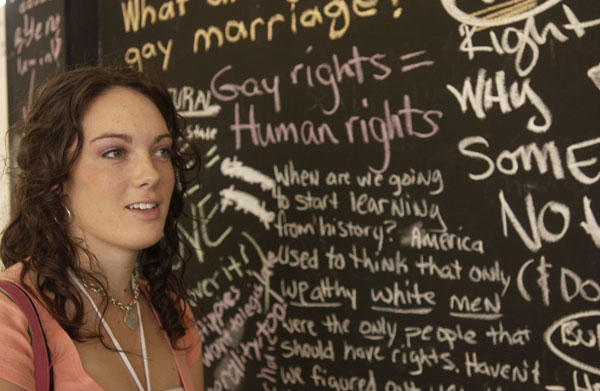
Sept. 22: A discussion of “Liberty, Equality, and LGBT Rights”

Ellen Anderson and Gary Welsh lead a Constitution Cafe discussion of the rights and equality of lesbian, gay, bisexual, and transgendered people as part of "My Daily Constitution"

When: Friday September 22, 8:00 PM – 10:00 PM

Where: Outward Bound Books 625 North Street Indianapolis 46202 (317) 951-9100

What do “liberty” and “equality” mean in Indiana and the United States today? Do these words include LGBT people and our/their experiences? This discussion will use the real-life legal experiences of LGBT people in matters ranging from marriage to adoption to employment to explore how they/we "fit" into the Constitution.

One facillitator of the discussion will be Gary Welsh, a practicing Indianapolis attorney, and founder and editor of the blog site Advance Indiana. A native of Illinois, he was very active in Illinois Republican politics before moving to Indiana in 1990. After graduating from law school he lobbied various business clients before the Indiana General Assembly from 1993 to 1998 while working for a major Indianapolis law firm. He served as General Counsel for Novanis, an information technology company, from 1998 to 2002. He is a 1993 graduate of IU School of Law-Indianapolis and a 1984 graduate of Eastern Illinois University.

Another discussion facillitator will be Ellen Andersen, an IndyBuzz colleague in the department of political science at IUPUI. Ellen is author of Out of the Closets and into the Courts: Legal Opportunity Structure and Gay Rights Litigation, which explores the complex relationship between litigation and social change in the context of the gay rights movement. She has also written a series of articles with M. Kent Jennings on the impact of AIDS on political activism. She is currently developing a survey of the same-sex couples who received marriage licenses in San Francisco, Portland, Oregon, and Massachusetts during 2004. Because she works on hot button social issues, Professor Andersen is increasingly asked to comment on current events. She has testified about same-sex marriage on several occasions before the Indiana Legislature and is regularly asked to speak to community groups about marriage and other gay rights issues. She has been quoted in media outlets including the Los Angeles Times, ABC News, and the Associated Press.

For more information ...

Before the event, check out breaking national news about gay, lesbian, bisexual and transgendered news from Yahoo. Want to know what Hoosiers think about gay and lesbian individuals' rights? You might be surprised: we may not be San Francisco but we do believe in toleration and fairness. Of course this doesn't stop Indiana legislators from proposing some screwy legislation; but Indiana judges differ.

After the event you might want to learn more by going on the web. You can track the issue of gay marriage in Indiana here. Want to get involved in these issues? If you think gays in Indiana should be treated equally, Indiana Equality could be for you. If you think they shouldn't be treated equally, you might be happy with the Indiana Family Institute. (For IndyBuzz's view of these two groups, check here.)

About the venue: The Out Word Bound bookstore, located in downtown Indianapolis, specializes in gay, lesbian, bisexual, and transgendered books. Out Word Bound offers greeting cards, CDs, magazines, calendars, and gifts in addition to poetry, fiction, non-fiction, and other kinds of LGBT literature. Book signings, poetry jams, book discussion groups, writers’ groups and other events are held at Out Word Bound.

If you like this event ...

Several other MDC events examine groups that have been excluded or marginalized and are now struggling for equality. Pierre Atlas and Charlie Wiles help discuss a sense of shared identity for an American citizenry that is becoming more diverse every day; María Pabón López and Teo Cain wrestle with a different issue of the constitutional rights of those who aren't citizens; and Rod Bohannan and Amos Brown talk about groups that have for decades been shunted from political access. The differences between these groups highlight important challenges of each ... and may indicate that building alliances will not be easy.

To return to the IndyBuzz schedule of My Daily Constitution events, click here.

Sept. 23: Discuss whether U.S. Constitutional Rights apply to Non Citizens

A Spanish-English discussion of the constitutional rights and protections provided to non-citizens (legal or not), part of My Daily Constitution

When: Saturday September 23, 10:00 AM – 12:00 PM
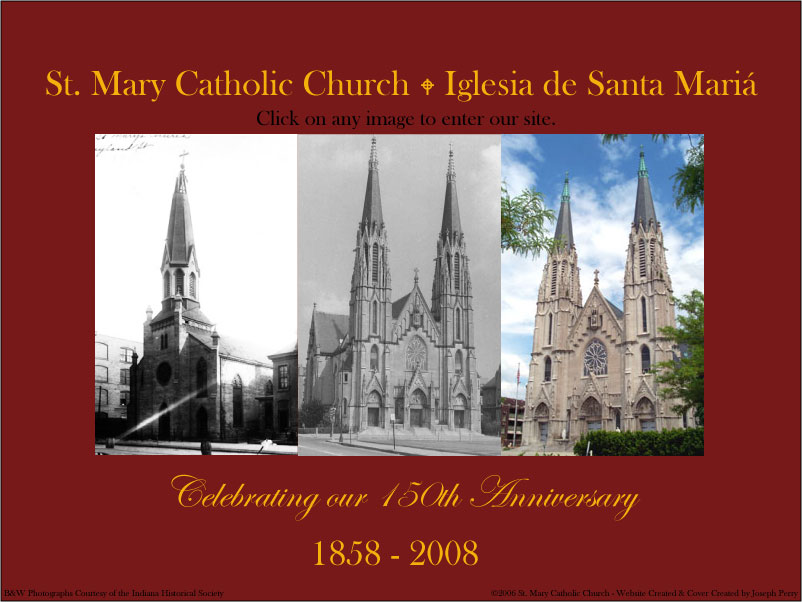
Where: St. Mary’s Catholic Church 317 North New Jersey StreetIndianapolis 46204

What are the rights of non-citizens? Do they have rights to free speech, protections in the work place? Should they have voting rights? What about free association, equal protection, criminal law, and other aspects of our Constitutional Democracy? How does it differ for undocumented noncitizens? This discussion, held in English and Spanish, will grapple with challenging issues at this significant time in our nation's immigrant history. Discussion Leaders will be Prof. María Pabón López (Indiana University School of Law Indianapolis) and Teo Cain (Community Organizer).

This should be a VERY interesting disscussion. I do work on immigration and must admit that I don't know as much as I should. From my reading of the Constitution, most of the Bill of Rights say what the government can't do ... to anyone, without specifying if it's done to citizens or noncitizens, legal or illegal immigrants. So I have some background reading to do. If, like me, you want to prepare yourself for this discussion (which doesn't have to mean brushing up on your high school Spanish), some suggestions. The good folks at Yahoo! collect general articles about immigration; so does Google. For news articles on immigration, visit Findlaw. Findlaw has another page with every link you need to learn about immigration law. For in-depth coverage of rights of immigrants, take a look at the ACLU's "Immigration Project." Check out the Center for Immigration Studies for a more skeptical perspective on immigration. For a counting of Mexicans in Indiana, check out Sagamore Institute's study Mexican-Indiana economic relations. (And if you want to know where to find a bunch of denunciations of this study, ask john@sipr.org ... the fingers of IndyBuzz cringe in protest and thus cannot make themselves type the site.)

If you like this event ...

You can discuss other groups whose struggles for dignity and protection from abuse are reshaping our understanding of democracy and the Constitution such as ethnic minorities and gay people. Perhaps Monday's discussion about a shared American identity for an increasingly plural populace will help provide a unifying framework for the rest of the week.

To return to the IndyBuzz schedule of My Daily Constitution events, click here.

Sept. 23: Environmental policy -- see it, taste it, debate, it, change it

Part of My Daily Constitution: A bus tour of the neighborhood around Citizen Gas & Coke; then a discussion of how citizens can become engaged in regulation of institutions such as Citizen Gas & Coke

When: 1:00 - 4:00 PM

Where: Family Center, Christian Park 4200 English Avenue Indianapolis 46201 (317) 327-7163

1:00-2:00 PM Bus Tour
“Case Study: Air Quality Indianapolis; A tour of an East Side Neighborhood” This bus tour will visit the neighborhood surrounding the Citizens Gas & Coke manufacturing plant on the east side of Indianapolis. Participants will discuss the recent air quality report issued by the Indiana Department of Environmental Management, as well as the radon study currently taking place in the area by the Washington D.C. based Alliance for Healthy Homes, whose members will be present. In cooperation with the Organization for Neighborhood Empowerment. Meet at Family Center, Christian Park at 1:00 PM; Bus departs at 1:15 PM; Refreshments provided.

2:00 PM – 4:00 PM Constitution discussion -- "Public Participation in Environmental Regulation: Theory vs. Reality"
State environmental agencies are charged with the protection of all citizens of the state. In reality, groups with the greatest resources exert a disproportionate influence on the enactment of environmental regulations. As Indianapolis redevelops its inner-city, and housing stock goes upscale, toxic environments, once considered more of a problem for poorer neighborhoods (as articulated by the Environmental Justice movement), has become everyone's concern. We have the studies and the enforcement actions, so what is preventing advances in creating a cleaner, more healthy Indiana? Could “business as usual” be the problem?

Discussion Leaders will be Michael Sutherlin of Michael Sutherlin & Associates and the Hoosier Environmental Council; and Dick van Frank of Improving Kid's Environment and a member of EPA's Title V Advisory Committee. Van Frank retired from the Lilly Research Laboratories in 1990 after 33 years. He research addressed viral vaccines, cell biology, biochemistry and molecular biology. Through his experience with Lilly, his environmental interests grew and eventually became a second vocation. He has served on numerous federal, state and local environmental advisory committees. He currently serves on the Wet Weather Technical Advisory Committee, the AWT Advisory Committee, the IDEM E. coli Task Force, and the Central Indiana Air Advisory Group. He also serves on the boards of Keep Indianapolis Beautiful; The Nature Sanctuary and Center; A. W. Butler Audubon Society, and is President of Improving Kids' Environment.

Check this out for a flavor of current controversies over environmental regulation in Indiana. Check out these sections of Indiana Law Blog for more technical background on environmental protection. This discussion seems perfectly paired with the previous MDC Constitution Cafe addressing eminent domain and the abuse of "takings" by the government. Two very different perspectives on the role of the government, and on who is most at risk: those owning property or those who bear the costs imposed on society by property owners? Try to see both.

To return to the IndyBuzz schedule of My Daily Constitution events, click here.

Sept. 23: Discussion of what the Constitution means for young people ... then Constitutional Hip-Hop Poetry Slam!

"My Daily Constitution" discusses the needs and concerns of young people and students ... then moves to an open mic "Hip-Hop Poetry Slam"

When: Saturday, September 23

Where: Glendale Mall -- 6101 North Keystone Avenue Indianapolis, Indiana 46220 (317) 275- 4410

5:00-7:00 PM Constitution Café discussion of “Constitution Who? Constitutional issues about Students and Young People” will be in the Glendale Library Auditorium

7:00 – 9:00 PM Hip Hop Poetry Slam + Open Mic “Constitution Who?” Featuring DJ Dicky Fox in the Glendale Mall First Floor Indoor Court

"My Daily Constitution" takes Indy where IndyBuzz has never gone before: an open microphone hip-hop poetry slam about democracy and the Constitution.

Here's a good question: Do minors have constitutional rights? The answer is "yes, but not as many as grown-ups." That answer fascinates me: how is it that constitutional rights and civil liberties attach themselves to a person a she gets older until that magic day when she turns 35 and has her entire bundle Constitutional rights? (She can run for President at that point.) The discussion of “Constitution Who? Constitutional issues about Students and Young People” should help clarify the issue. It will be led by two of the area's leading experts in the field:

Jackie Bowie Suess is a lawyer for the American Civil Liberties Union of Indiana (ACLU-IN). She is a graduate of Miami University and Indiana University School of Law, Bloomington. She was a lawyer for Legal Services Organization in Indianapolis for four years, and began working for the ACLU-IN in 1997. Jackie was the Director of the Indiana Constitutional Justice Initiative, a welfare rights project of the ACLU-IN, from July 1997 to May 2000, and Director of the ACLU-IN's Children's Rights Project in 2000-2001. She authored a reference book on welfare reform entitled "Welfare Reform in Indiana: A Practitioner's Desk Book." She currently does general litigation at the ACLU-IN, with an emphasis on the constitutional rights of children and the poor.

Warren Watson is director of J-Ideas, a Ball State program designed to encourage and develop high school journalism students. Prior to his work at Ball State, Watson was vice president for extended learning and operations at the American Press Institute, where he also served as co-president and associate director during his time there. While at API, Watson led workshops on newsroom issues, management and leadership, marketing and advertising.Watson also has been active in the Society for News Design since 1987, and served as president of the Society in 2003. A native of New Hampshire, Watson earned a bachelor's degree from the University of New Hampshire in 1973.

After the discussion in the Glendale Mall Library, the excitement spikes even more with a move downstairs to the First Floor Court, where there will be a Hip Hop Poetry Slam + Open Mic “Constitution Who?” According to My Daily Constitution:


Did you know that our Constitution was written by revolutionaries? Bring
your best poems and lyrics -- this is your mic to represent you and your
generation. Make your voices heard. Peace!

I am trying to tell myself that this is not too hip for IndyBuzz ... I'll be there! The Hip Hop Poetry Slam + Open Mic will feature one of the area's hottest Djs, DJ Dicky Fox and is presented by United States of Mind.

About the venue: The Glendale Mall is my favorite example of the changing civic role of shopping malls. When it first opened in the 1950s, it was an open air mall. Soon, however, it was enclosed and became the city’s first indoor shopping mall. A few years ago, as malling activites shifted out to the other side of I-465 and the WalMart a mile up Keystone sucked away business, Glendale seemed on the edge of following similar malls and closing. Instead it reinvented itself as a hub of education and civic activities. With renovations it continues to be an indoor shopping mall, complete with a 12-screen theater. It has a branch of IUPUI, the very vital older adult education program OASIS, and the country’s first full-service library located in a shopping mall.

To return to the IndyBuzz schedule of My Daily Constitution events, click here.

Sept. 24: My Daily Constitution Film Festival at IMA

Watch three critically acclaimed documentaries about the impact of the Constitution on US domestic and international policy, as well as the efforts of American political pros to foster the best (and worst) of American democracy in Bolivia

When: Sunday Sept. 24, 11:00 AM - 4:30 PM

Where: DeBoest Lecture Hall Indianapolis Museum of Art 4000 Michigan Road Indianapolis IN 46208, 317-920-2660

Free and open to the public

Three recent documentaries have turned a critical eye on what American democracy means to the rest of the world. Americans are justly proud of our Constitution, and believe that the rest of the world admires (and even envies) our democratic traditions. But how do we in fact look to the world? How do outsiders expect American government officials and politicians to behave, and what do they think when American political behavior falls short of America's lofty political ideals. All three documentaries will be screened at the Indianapolis Museum of Art on the final day of "My Daily Constitution."

11:00 AM
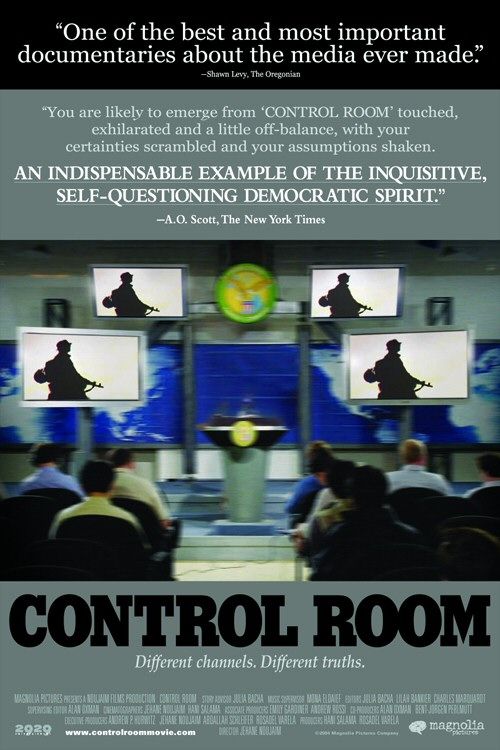
Control Room
(2004, USA/Iran, dir. Jehane Nouiam, 84 mins.)
A documentary about the perception of the United States's war with Iraq, with an emphasis on Arab language TV network Al Jazeera's coverage.


1:00 PM
Persons of Interest
(2004, USA, dirs. Alison Maclean & Tobias Perse, 63 mins.)
A documentary about the detention of Muslim-Americans in the wake of 9/11.


2:30 PM
Our Brand Is Crisis
(2005, USA, dir. Rachel Boynton, 87 mins.)
A documentary about Bill Clinton's adviser James Carville and other American political consultants designing an election campaign in Bolivia.

To return to the IndyBuzz schedule of My Daily Constitution events, click here.

Sept. 24: Rod Bohannan and Amos Brown on “The Right to Vote and American Constitutional Democracy”

Part of "My Daily Constitution," this Constitution Cafe will examine why you can't be sure whether you will be able to vote, and whether your vote will even count if you cast it.

When: Sunday September 24, 4:30 PM - 6:30 PM

Where: Bethel African Methodist Episcopal Church, 414 West Vermont Street, Indianapolis 46202 (317) 634-7002

For decades Rod Bohannan (Indiana Legal Services) and Amos Brown (WTLC-AM Radio) have been lions in defense of the poor and unrepresented in Indianapolis. Who better to lead a discussion of whether Indiana and the rest of the country progressing is progressing in making voting more accessible and more fair? This concluding discussion of the "My Daily Constitution" series will examine the history of voting in Indiana, advances, setbacks, and will ask what can be done about this fundamental practice of our democracy.

About the venue: Bethel African Methodist Episcopal Church is the oldest African-American Church in Indianapolis. Founded in 1836 by a group of African-American Methodists, it was served by circuit ministers until the 1850s. In the later 1860s, the church adopted the name Bethel AME and built its current structure on West Vermont Street. Bethel AME was a stopover on the Underground Railroad and was the location for the founding of the State Federation of Colored Women’s Clubs and the Indianapolis Chapter of the NAACP.

Before the event, you might want to read up a bit on the tensions engendered by the recent debate over the Voting Rights Act. Check out articles from the Boston Globe, and from the American Prospect. We have seen these problems at home with controversies over the sorts of identification needed to vote (which raises the touchy question of who might not possess those sorts of ID); and the ways i which voter rolls are being purged. For those who wish to go deeper in elector law, you can find out about everything happening around the country at http://electionlawblog.org/.

If you like this event, you should also attend the discussions of rights for non-citizens and gay persons. You should also discuss the changing notion of American identity.

To return to the IndyBuzz schedule of My Daily Constitution events, click here.

Sept. 25: Henry Rosemont on "Is China's Modernizing Economy a Threat to the US?"

Brown University Professor, Henry Rosemont, will give a lecture for Butler's Change and Tradition Program's convocation

When: September 25, 7:00 PM

Where: Butler University Krannert Hall, Clowes Hall

Henry Rosemont is one of the great Western scholars of the history Chinese philosophy. For nearly three decades, if you want to learn about ancient Chinese thinking about religion, language, morality ... it seemed you would essentially be cribbing from a two-week Harvard faculty workshop that Rosemont and Benjamin Schwartz organized in 1976. (I have a very well-worn copy of Rosemont and Schwartz's excellent collection Studies in Classical Chinese Thought that helped me as a grad student to pretend to know a lot more about Chinese philosophy than was healthy.) We are fortunate to have a distinguished scholar of Chinese culture address a topic that is all too often left to economists or geo-strategists.

Sept. 25: Opening of "25 above water"

This is the first showing of "25 Above Water," a collection of limited edition posters by artists from around the country to provide relief for the victims of Hurricaines Katrina and Rita

When: Opening Reception: Monday, September 25, 6 - 9 pm; exhibit shows September 25 - 30

Where: Herron School of Art and Design, Marsh Special Projects Gallery 735 West New York Street, Indianapolis

In the days following hurricanes Katrina and Rita a group of fellow artists united to aid hurricane relief efforts by creating "25 Above Water," a collection of limited edition posters by artists from New York City, Rhode Island, Cleveland, Chicago, Kansas City, Lincoln, Minneapolis, Seattle, Portland, San Francisco, and Indianapolis. This September the 25 Above Water art collection, by artists/designers from throughout the United States, will be on display for the first time ever in the new Herron School of Art and Design building in downtown Indianapolis.

Opening reception is September 25, 2006 from 6 pm - 9 pm. Among the 25 Above Water participating artists planning to attend the opening are Eric Kass, Michael Norman Olson, Jonathan McGlothin, and 2006 AIGA Medalist Rick Valicenti of 3st. The AIGA Medal is the highest honor, awarded by the AIGA - The Professional Association for Design, in the field of graphic design to designers for their exceptional achievements in graphic design and visual communication. A lecture and presentation by Rick Valicenti (sponsored by the Herron School of Art and Design, Dept. of Visual Communication) is tentatively scheduled for Sept. 25 right before the opening reception.

"25 Above Water" is an exhibition well worth attending, and has received national and international attention. Organized and curated by Indianapolis artist and graphic designer Sam Vázquez, "25 Above Water" is an event that Provocate (successor to IndyBuzz) will examine at greater length, along with Vázquez's "Department of World Service."

Oct. 3: readings by Mexican and Belarussian poets

Butler University's Vivian S. Delbrook Visiting Writers Series presents readings by two highly acclaimed young poets: Ekiwah Adler Beléndez (Mexico) and Valzhyna Mort (Belarus)

When: Tuesday, October 3 7:30 PM
Where: Butler University Robertson Hall, Johnson Room

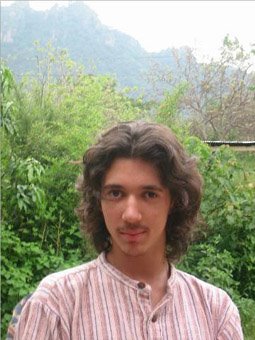
Ekiwah Adler-Beléndez and Valzhyna Mort are two of the world's most promising poets under the age of 25. Ekiwah Adler-Beléndez, from Amatlan, Mexico, a small village an hour from Mexico City, will have turned 19 [!] two weeks before this event. The son of a North American father and a Mexican mother, his powerful verses have mesmerized Mexico's literary scene for the better part of a decade. Adler-Beléndez is the author of three volumes of poetry: Soy (I Am); Palabras Inagotables, (Never-ending Words); and Weaver (2003), his first book in English. A bilingual collection of New and Selected Poems is in the works. Check out his bio here, and his website here.

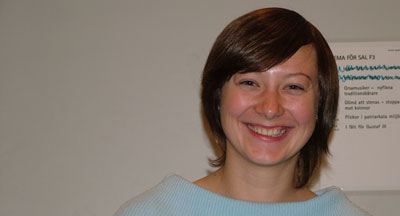
Compared to Ekiwah Adler-Beléndez, Valzhyna Mort's 25 years make her seem like a seasoned veteran of the world of international poetry ... and she is. Born Valhyna Martynava in 1981 in Minsk, Mort is famed throughout Europe for her poetry and how she reads it ... or more accurately, how she performs it. She writes in Belarusian at a time when efforts are being made to reestablish the traditional language, after governmental attempts to absorb it into the Russian language have been relinquished; at the same time, the Belarusian government is the last enclave of Communist-style repressiveness in Europe, and its president Lukashenko still aspires to recreate something like the USSR. Mort reads her poems aloud in both Belarusian and English. Learn more about her here. Examples of her poetry can be found here.

In addition to poetry readings, she speaks on "The Politics of Language and The Poetry of Revolution" ... I hope to announce a talk by Mort on this topic as well, stay tuned to IndyBuzz for more information.

This is not the first time Mort and Adler-Beléndez have appeared together. This is from a review of their joint appearance earlier this year Berkshire School (MA):


Poets Valzhyna Mort from Belarus and Ekiwah Adler-Belendez from Mexico visited Berkshire School on April 7. While many Berkshire students attended the reading at the urging of their English or foreign language teachers, others attended for fun. Most gained a deep respect for the poets and their experiences, and several students were even moved to tears by the end of the presentation. Despite the stark difference between their life experiences and respective writings, the two poets made a profound impact on their young audience.

Valzhyna Mort, a 24 year old woman from Minsk, Belarus, has earned fame throughout Europe and the United States for her poetry and her powerful readings. Her presentation began with her reciting a poem in her native language of Belarusian, and her tone of voice was loud and emphatic. She spoke with vigor and energy, and one could easily tell that she was very passionate about what she was doing. As it turns out, much of Mort's poetry is political, speaking about the struggle of the Belarusian people to preserve their own language.

Ekiwah Adler-Belendez is an 18 year old from Amatlan, Mexico. Although he has cerebral palsy, he has not let this illness negatively affect his life or work. Ekiwah seemed very comfortable in his wheelchair on stage, taking time to observe the whole audience between poems. His personality was very calming and welcoming, and to see the young author sharing his words that night moved nearly everyone in Allen Theatre. Ekiwah's attitude and demeanor immediately captivated the students and faculty in the audience. After both poets had completed their readings, they went up together and read one of each others poems.


Ekiwah Adler-Beléndez and Valzhyna Mortwill will appear at Butler,
but not flanked by Berkshire teachers
(and not with the backdrop of Berkshire Hills)
Co-sponsored by the Consulate of Mexico and the Indianapolis-Marion County Public Library

Welcome to IndyBuzz

IndyBuzz provides information about Central Indiana's most stimulating and thought provoking events -- discussions and conferences, art exhibitions, films, music performances. It tells you what's happening … explains why you should be part of what’s happening. More than an events calendar, though, IndyBuzz tries to make events more meaningful for participants by suggesting an article or two to read before the event, recommending books or websites that will be sources of further information after the event, and pointing out related events that are worth attending.

Visit IndyBuzz's sister site, http://www.provocate.org/, which provides a context for the clusters of the events discussed in IndyBuzz.

Who is IndyBuzz?

Provocate strengthens the intellectual and civic fabric of Central Indiana by connecting global & local, entertainment & education, culture & policy