Nov. 12: Generations of Immigrant Experiences: Poetry Reading and Historic Walking Tour


A chance to gain a new appreciation for the German presence in Indiana from two of the German community's most important persons

When: Saturday, November 12 1:30 PM - 4:00 PM

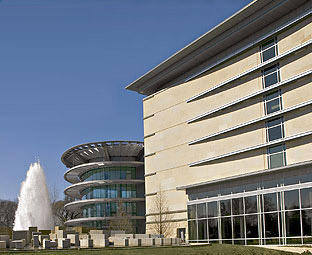
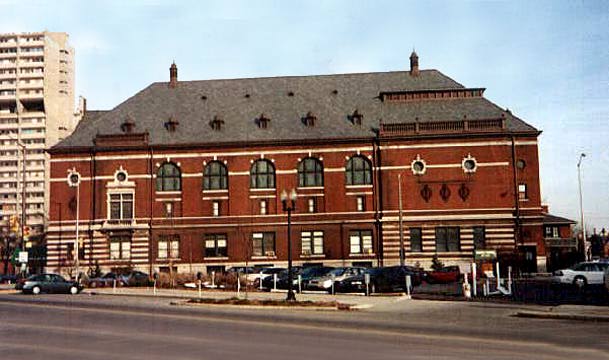
Where: The Athenaeum, 401 East Michigan St. Indianapolis

In the restored Athenaeum, built by German immigrants, poet Norbert Krapf will read from his work about his family’s multi-generational immigrant experience, a true story of moving and staying. Selections include poems that tell the story of his Franconian ancestors’ journey to the Southern Indiana wilderness, growing up in the rural German community, a move to the East Coast and his children’s arrival from Colombia, and the family’s final return to Indiana. (For those of you who are as poorly informed about Germany and the German language: Franconia is part of Bavaria; Franconian German is a very broad cluster of dialects including Dutch German and Afrikaans ... if Giles Hoyt reads IndyBuzz, I am sure to get an e-mail correncting me, thanks in advance Giles.)

According to an e-mail today from Norbert:

I am back from a stimulating and productive trip to Germany, where I spent time with my poet and playwright friend Helmut Haberkamm, whose new dialect play premiered during my visit and whose new book of Franconian translations and adaptations of American and English songs, including a number by Bob Dylan, is just out. While I was there in Erlangen, where we lived 1988-89, Helmut also did two performances with singer-songwriter Johann Muller based on these Franconian adaptations, which inspired me to write “The Franconian Tambourine Men," and I also read my poems to several classes at Helmut's Gymnasium.I came back with new ideas and lots of new poems.

After the reading, Giles Hoyt, Director of the Max Kade German-American Center, will lead a walking tour of the Athenaeum and several German-American sites in the vicinity. In case of inclement weather, the walking tour will be replaced by a slide presentation.

Questions? Call 274-2330 or e-mail Giles at ghoyt@iupui.edu.

Nov. 13: An evening with NPR's Diane Rehm


Discussion of current events and disabilities with National Public Radio talk show host Diane Rehm

When: Sunday Nov. 13 7:30 PM

Where: Indianapolis Hebrew Congregation 6501 North Meridian Street Indianapolis, Indiana 46260

Listeners to public radion are well acquainted with the distinctive voice of Diane Rehm, host of The Diane Rehm Show on National Public Radio. The award winning program has been distributed by NPR since 1995 to stations around the world and has 1.4 million listeners. Diane also has forged a successful career as a writer. In Finding My Voice, Ms Rehm talks about her childhood, marriage, broadcast career, and vocal difficulties. With her husband, Ms Rehm co-authored Toward Commitment: A Dialogue about Marriage, which focuses on the art of building and maintaining a strong relationship. In 1998, she was diagnosed with spasmodic dysphonia, a neurological condition that causes strained, difficult speech. After finding treatment, she has written several articles and produced a program about the little known disorder. Ted Koppel, ABC’s Nightline host devoted an entire program to a conversation with Rehm about her disorder

You should buy your tickets now, this is certain to seel out.

Nov. 14: An Intimate Taste of Mass. Ave.


A chance to sample food from three of the city's finest restaurants, and to talk to the architects who helped make these such appealing spaces

When: Monday Nov. 14 5:30 PM - 9:30 PM

Where: Elements (415 N. Alabama St.), The Scholars Inn Gourmet Café & Wine Bar (725 Mass Ave.); R Bistro (888 Mass Ave.)

Explore the sights, sounds, and tastes of Massachusetts Avenue, the city's uniquely creative new cultural district. Enjoy a progressive meal presented by three Indianapolis restaurants and the architects who designed them—Elements by Demerly Architects; The Scholars Inn Gourmet Café & Wine Bar by Rowland Design Inc.; and R Bistro by J. W. McQuiston Architecture. As you sample one course at each restaurant, engage in lively discussions with the owners and architects about creative transformations that are enriching Massachusetts Avenue. Learn how businesses can creatively move into older neighborhoods. Discuss what matters to you as Indianapolis creates and redefines urban neighborhoods and districts, making them wonderful places to stay.

(Wish I would have known about this event before agreeing to talk about the UN at the University of Indianapolis that evening! Part of what makes all three restaurants so successful is the creative use of space.)

$30 includes appetizers and dessert. Free soft drinks and water. Cash bar. Registration is limited to 120 people. Advance registrations are required by November 7, 2005. For questions and reservations contact Lee Borthwick at 317-822-9299 or email lee@bomaindy.org.

Nov. 15: Revaluing the Chinese Yuan — Opportunity or threat?


The World Trade Club's dinner and talk by the purchasing manager of Cummins Engines and a very bright Ball State business professor

When: Tuesday November 15 — registration and social hour 5:30-6:30 Pm; dinner at 6:30

Where: Omni Severin Hotel Downtown 40 W. Jackson Place Indianapolis, IN 46204 (parking at Circle Center Mall)

So here's what I think about the controversy over the value of the Chinese yuan. It's definitely valued less than it would if it was allowed to float, and that is intended to help promote Chinese exports. The situation is similar to Japan in the 1970s and 1980s. By keeping the value of your currency low you make it cheaper for outsiders to buy your stuff while making it more expensive for your own people to buy stuff produced by outsiders. That means Chinese consumers are being penalized so American consumers can buy Chinese-made goods more cheaply. Woo-hoo!

Of course the Chinese government isnt doing this to be generous to Americans. The purpose is to capture global market share for Chinese firms, and to ensure Chinese workers will have jobs. Just like Japan before it. Allowing the yuan to float on the market might help some American companies increasing their exports to China (although it would also spur exports from Europe and Japan and Korea too), and it might lead some American purchasers to consider buying American goods which would be cheaper relative to Chinese products. But it would have nothing to do with global job shifts (China is sucking low-pay jobs not from America but from Mexico and other developing countries). It might even help cool down China's overheated economy. Revaluing the yuan would definitely expose the Chinese economy to new uncertainties and instabilities, and that might not be a good thing for the world economy. Increasing unemployment in China (already one of the biggest worries for the Chinese leaders) could destabilize China's political system. That could be good, Solidarność helped topple communism in Poland. It could be bad, appealing to economically hurting Germans helped Hitler gain support.

My sense is that American leaders who reduce our problems down to improperly valued yuan are trying to divert attention from bigger political and economic problems. No wonder economics makes me nervous.

The World Trade Club's dinner in November should help make sense of this issue. Dennis Kelley has been President of Pacific World Trade in Indianapolis since 1986. Previously, he served as Partner of Alliance for Global Commerce with Governor Robert Orr, Director of China Operations for Cummins Engine Company (1978-1984), and Regional Manager of Middle East for Cummins Engine Company based in Tehran, Iran (1975-1977). In China, Mr. Kelley was responsible for all commercial and legal negotiations for licensing technology and direct sales, set up their Beijing office in 1982, and set up initial distribution system. Mr. Kelley has done several presentations and lectures on China in Yale University, John Hopkins University, Columbia University, Indiana University Business School, American Graduate School of International Management, Chicago Council on Foreign Relations, U.S.-China Business Council in Washington, D.C.

Srinivasan Sundaram is a very bright professor of international finance at the Miller College of Business at Ball State. Ph.D. in finance from University of Cincinnati in 1991. He teaches Corporate Finance and Global Business classes. Srinivasan won the “UniversityTeaching Professor” award in 1994- 1995. Srinivasan has published papers in Financial Management, Financial Analysts Journal and The Journal of Financial Education among others. He serves as the Internship coordinator and the departmental advisor to the Finance & Insurance department in the Miller College.

Event Cost: $30 for World Trade Club members; $40 for non-members; $25 for full-time students
To make a reservation: Tel: 317-261-0918; Fax: 317-888-6152
E-mail WTC Administration

Nov. 16: How Leaving and Staying Affects Our Philanthropy

A discussion with experts from the Center on Philanthropy

When: Wednesday, November 16 11:30 AM

Where: Marott 2625 N. Meridian St Indianapolis

IU's Center on Philanthropy is perhaps the country's leading institution for understanding civil society and voluntary action. This is achance to peek inside the discussions that go on in the Center. A panel of experts will discuss philanthropy from the point of view of those who have moved and those who both move and stay, making community in two different places. (Don;t worry: That sounds like the sort of description designed for a program to fit within Spirit & Place's desginated theme of "moving and staying" ... it should make sense in the discussion!)

The panel involves four of the Center's specialized programs:

  • the Lake Family Institute on Faith and Giving, which explores the relationship between faith and giving in the various religious traditions.
  • the Women's Philanthropy Institute, which seeks to inspire women to reach their potential as givers
  • the Philanthropy Incubator, which provides high-quality philanthropy education, training, and consulting services to help people learn to support causes they care about by giving their time, their talents, and their financial support in the most effective and strategic way
  • and The Fund Raising School, which for 30 years has taught ethical fundraising

Featured panelists will discuss how being residents in multiple locations shapes their philanthropic interests and the challenge of fundraising with donors who have multiple residences and loyalties. The panel will include:

  • Eugene R. Tempel, Executive Director of the Center on Philanthropy at Indiana University, and Professor, Higher Education, Philanthropic Studies, and Public Administration at Indiana University-Purdue University Indianapolis.
  • Una Osili is an Assistant Professor in the IUPUI Department of Economics. Professor Osili’s research lies within the field of development economics. In particular, she studies how households in developing countries make economic decisions where incomes are low and variable, and especially in the presence of market imperfections. In her research, Professor Osili has collected and analyzed data in Nigeria and the United States on the transfers that immigrants send to their home families. Currently, Professor Olisi is studying the private income contributions and institutions using data from Indonesia. She plans to examine transfers to community-level institutions in other parts of the developing world and the role that community groups can play in the process of economic development
  • George Rapp, orthopedic surgeon who has played an important role in IU Med school fundraising
  • David Smith, who taught courses on medicine, religon, bioethics, and philanthropy at IU. For the last 20 years of his tenure Smith directed the Poynter Center for the Study of Ethics and American Institutions. In addition, in collaboration with the Center on Philanthropy, the Poynter Center has been heavily involved in projects related to the moral issues in philanthropy. Smith served as a visiting professor of bioethics in the Institution for Social and Policy Studies at Yale for the 2003-4 academic year.
  • Chester Browne, philanthropist

The venue for this Spirit & Place panel will be the noon luncheon meeting of the Indiana Chapter of the Association of Fundraising Professionals.

Nov. 5: Absence of Our Presence — The Eiteljorg Fellowship for Native American Fine Art Symposium

A discussion of Native American art and its relation to the mainstream

When: Sunday 5 November 10:00 AM - 6:00 PM

Where: Eiteljorg Museum of American Indians and Western Art, 500 West Washington Street Indianapolis, IN 46204

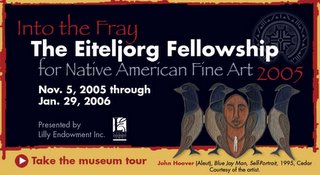
Every other year the Eiteljorg Museum awards six Eiteljorg Fellowships for Native American Art to a distinguished artist for lifetime achievements and to five contemporary fine artists. A Very competitive, very prestigious, and worth some $20,000. Those selected in 2005 include:

Harry Fonseca (Maidu/Nisenan Portuguese, Hawaiian) expresses through his paintings the time and space in which we live, often whimsically reflecting the myths and ways of painting found throughout the world.
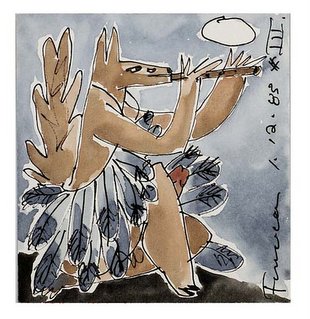
Harry Fonseca, Flute Player #3 (1983)
In his paintings, Fonseca recognizes influences from African, Native American and contemporary art from North America.


Harry Fonseca, Illumination (2001)

Extensive travels to Germany, Spain, the South Pacific, Mexico, Central and South America and Japan have allowed Fonseca to explore other cultural connections.

Tanis Maria S'eiltin (Tlingit) seeks to honor those who work in the best interest of her cultural heritage.

Tanis S'eiltin Spawning a Red millennium

As a mixed media artist, her art reflects the ability of indigenous people to retain their cultural heritage despite corporate and U.S. government standards of identification. She believes that indigenous people are rich in culture and possess the ability to survive, to adapt and still maintain their identity.

C. Maxx Stevens (Seminole / Muscogee Nations of the Oklahoma Region) creates installations that carry on the storytelling tradition in a visual language. Each installation is based on her journey in life, her experience as a native person, her motivation and beliefs, and her family. For instance, her installation Four Directional House (2003)

is a reflection of her experiences growing up in a large, Seminole family in Wichita, Kansas. Like many Native people she was confronted with the conflicting interests of Christianity and indigenous interpretations of the world. The cross-shape of her suspended dwelling refers to Native understandings of the four directions, but could also refer to Christianity. The experience of living in a small home with up to ten family members is evoked through the thin walls of the structure. Much like the shadow of an airplane moving across the landscape of her childhood, the cross-shaped shadow on the Astroturf is impermanent.

James Lavadour (Walla Walla) worked for his Tribal Government for nearly 15 years in education, alcohol and drug treatment and land use planning.

James Lavadour, Overland (2003)

In 1990, he founded an organization called Crow's Shadow Institute for the Arts providing social, economic and education opportunities to Native Americans through artistic development. A self-taught artist, I find his paintings very familiar because they are so clearly drawn from the hills of Eastern Oregon where my family (like Lavadour's) are rooted.
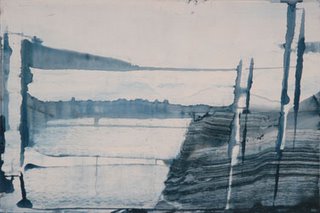
James Lavadour, Down River (2005)

Marie Watt (Seneca) works mainly in lithographs and sculpture. Born to the son of Wyoming ranchers and a daughter of the Turtle Clan of the Seneca Iroquois /Haudenosaunee) Watt identifies herself as "half Cowboy and half Indian." Formally, her work draws from Indigenous design principles, oral tradition, personal experience, and Western art history. Her approach to art-making is shaped by the proto-feminism of Iroquois matrilineal custom, political work by Native artists in the 60s, a discourse on multiculturalism, as well as Abstract Expressionism and Pop Art.
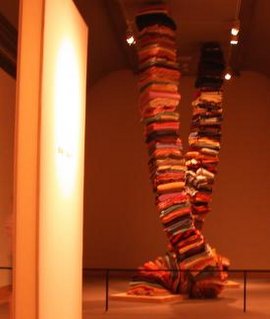
Marie Watt, Blanket Stories

Like Jasper Johns, she interested in "things that the mind already knows." Unlike the Pop artists, she uses a vocabulary of natural materials (stone, cornhusks, wool, cedar) and forms (blankets, pillows, bridges) that are universal to human experience (though not uniquely American) and noncommercial in character.

2006 Distinguished Artist: John Hoover (Aleut) is known for his intricate carvings which draw from myth, both cultural and personal. Seaweed People was installed in 1998 in the First LadyÂ’s Sculpture Garden at the White House.
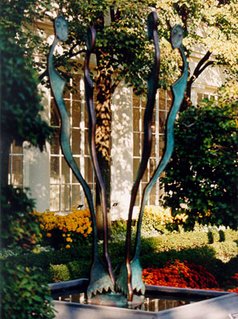
John Hoover, Seaweed People

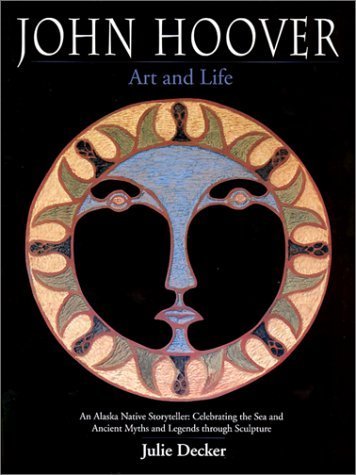
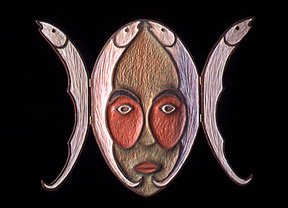
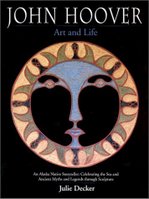
Of Aleut-Russian and Dutch heritage, Hoover says he grew up rough; from the age of seven he had to fight for money, and when he was old enough, he fished, dug clams, and did odd jobs to support himself. For a long time he attempted to paint, withosuccessh success, but when he was 41 he discovered carving and began to focus on Aleut culture as well as the Tlingit, Salish, and Haida myths of the Northwest Coast. The resulting carved cedar panels are infused with the spirit of these cultures. Sad, bewildered, calm, or wise faces look out from involved animal figures in shallow carvings, triptychs, or hanging forms, infused with soft natural colors. The elongated, overlaid figures often involve the theme of a spirit helper restoring lost portions of one's soul. Hoover has gone past the traditional Northwest Coast art to create his own style and technique. For a retrospective of Hoover's work at the Anchorage Museum of History and Art, curator Julie Decker wrote a fascinating biography, John Hoover: Art and Life. $60 is definitely worth the lavish reproductions of his art, and while you can get the book used, if you want simply to read Hoover biography you can read Decker's text here, here, here, here, here, and here. (Thanks to the good people at Google! for their caching feature that keeps pictures of pages even after they have been removed from the web.)
You ought to visit the Eiteljorg to view the works of these artists -- they are on exhibit from Nov. 5 to Jan. 29 2006. It will be yet another reminder of why Central Indiana is emerging as one of the country's most vibrant hubs of cultural and artistic life. To learn more about the issues that have shaped these and other Native American artists you ought to attend the Eiteljorg Fellowship for Native American Fine Art Symposium, which will address issues in and around the exhibition of Native American fine art and its relationship with the mainstream. What is the role of the artist? Is it different for mainstream and indigenous artists? Where is the ethno-critical voice that represents Native American interests within the mainstream museums and galleries? The symposium will strengthen the appreciation for the substance of Native American fine art in the context of our popular culture.
The symposium will incorporate two roundtable discussions, 3 panels, and a key note speaker. Each panel will consist of one moderator, and three panelists. Panel make-up will incorporate one representative from the mainstream community and two representing Native American interests.

10:00 - 11:30am Roundtable discussion. Among the questions that will be raised and will be probed throughout the day:

  • What is the role of the artist?
  • Is that role different for indigenous and mainstream artists?
  • Who defines what fine art is?
  • Why do Native American and First Nation artists have difficulty competing in the mainstream?
  • Do First Nations artists have a more or less difficult challenge than Native American artists?
  • What are some of the issues Indigenous artists share with other cultures i.e. Asian, Latino challenges in the mainstream? What are the differences?
  • What does a perfect contemporary art world look like? Why canÂ’t we get thereparticipantsp>Particiapnts will include:

Amei Wallach, President emeritus of the International Association of Art Critics/USA

Jessie Ryker-Crawford (White Earth Anishinabe/Chippewa) anthropologist

Kay WalkingStick, Cherokee artist

Margaret Archuleta (Tewa/Hispanic), co-author of Shared Visions: Native American Painters and Sculptors in the Twentieth Century

Patterson Sims, Director, Montclair Art Museum

11:45 - 12:45pm Lunch and Keynote speech
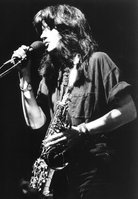
Joy Harjo (Mvskoke/Creek Nation) internationally known poet, performer, writer and musician. She has published seven books of acclaimed poetry. She co-edited an anthology of contemporary Native womenÂ’s writing: Reinventing the Enemiy's image: Native WomenÂ’s Writing of North America. Musically, she has been recognized by Pulse Magazine and by the First Americans in the Arts for Outstanding Musical Achievement. She has performed worldwide from Norway to India. Harjo is the Joseph Russo endowed professor at the University of New Mexico. This should be a treat, especially if Harjo performs any of her music. The politically cutting, often bitter lyrics of her music runs counter to her soft jazzy melodies and gentle voice.

Listen to Morning Song

Listen to Fear Song

1:00-2:00 PM Perception and Reality: Who's defining whom? Among the questions that are likely to be raised:

  • How are misperceptions created in the dominant culture and reinforced by the mainstream art world?
  • What are subtle ways Native Americans are marginalized and kept out of mainstream art?
  • What roles and responsibilities do institutions, like the Eiteljorg Museum and similar institutions, have in exposing indigenous artists to the mainstream art world?
  • And finally, is the mainstream experience simply overrated?

Moderator: Lowery Stokes Sims, director of the Studio Museum in Harlem

Margaret Archuleta

Paul Chaat Smith, one of the country's leading voices on voices on issues of American Indian art, identity, mass culture and politics and co-author of Like a Hurricane: The Indian Movement from Alcatraz to Wounded Knee

Patterson Sims

2:15-3:15 PM Representation and Identity: Who owns the image of Native Americans? Some of the questions to be discussed:
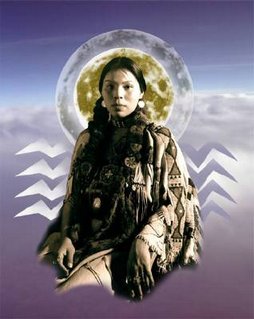
  • How are indigenous artists changing the representation of Native People in film and photography?
  • How similar or different is this representation to that of other indigenous cultures historically or in the contemporary mainstream?


Moderator: Brenda Child (Chippewa) professor of history at the University of Minnesota

Leanne Mella, U.S. Department of State Bureau of Educational and Cultural Affairs

Hulleah Tsinhnahjinnie (Dine/Seminole/Muskogee) photographer and artist

Shelley Niro (Mohawk), photographer

3:30-4:45 PM Individualism, Community, and the Dominant Society: What can indigenous artists teach the mainstream? The cult of individualism fuels the creative expression of most contemporary artists. How does the role of community in indigenous art create a more universal experience that many contemporary artists are able to achieve?

Wonsook Kim, painter

Jessie Ryker-Crawford (White Earth Anishinabe/Chippewa)

Kay WalkingStick

5:00-6:00pm Roundtable Discussion: Enduring and Change: What's next? In conclusion, there will be a roundtable discussion with the five Eiteljorg Fellows. In this case there will be a moderator who will address panel issues as they relate to the artists' individual experiences and art work.

Now that's a symposium!

For more information, check out ... the press package put out by the Eiteljorg. Note in particular the essay by the Eiteljorg's curator of contemporary art Jennifer Complo McNutt.

If you like this event, you should check out ... the Spirit & Place discussion of arts gravitating toward Indianapolis on Nov 17.

Thematic overview of upcoming buzz-worthy events

With so many events coming up in the next few weeks, it might help to see some of the thematic clusters.

Africa

Art & culture

Education

Environment & ecology

Ethnic relations

Film

Food (eating and thinking)
Gender and society

Global business

Glocalization

Immigration and assimilation

Interfaith relations

International relations


Journalism

Middle East

Music

Peacemaking

Philanthropy

Political reform


Poverty at home & abroad

Value conflict & consensus

Nov. 3-6: The 2005 International Festival — Indiana's Global Block Party


The best way to get the feel glocal — global+local — of Indianapolis

When: Nov. 3-6
Special Hours for School and Student Groups

Festival 2005 Welcomes All!

  • Friday, November 4.....3 to 9 p.m. (open to the public)
  • Saturday, November 5.....10 a.m. to 9 p.m. (open to the public)
  • Sunday, November 6.....Noon to 6 p.m. (open to the public)

Where: Exposition Hall, Indiana State Fairgrounds, 1200 East 38th Street, Indianapolis

Discounted tickets are available from ethnic groups participating in the International Festival until Nov. 3. Advance sale discount tickets are available at AAA Hoosier Motor Club branch offices and Marsh Supemarkets from Oct. 10 through Nov. 3. Tickets at the door are $9 for adults, $6 for children 5-12; children 4 and under are admitted free.Information on tickets (including student tickets) at 317:236-6515 ext. 106 or e-mail.

This is the Big One for ethnic Indiana. Go and you won't be able to think the same way about "white bread" Indianapolis. Dozens of foods, demonstrations of arts from various cultures, songs, costumes ... what a treat. Let's doff our colorful regional hats to the Nationalities Council of Indianapolis for making this possible.

But the International Festival ought to be a small part of engaging yourself in Glocal Indianapolis. When you scroll down through the events featured in IndyBuzz you ought to get a sense of how many groups and individuals are working every day to educate the rest of us, to connect the residents of Central Indiana to the rest of the world, to make us better and perhaps to help solve some of the bigger problems facing the world. It ought to be a reminder that for many of us, every day is International.

Oct 28: Mexican Folklore Show -- embrace new cultures and help save a life


A benefit performance by the award-winning Ensamble Folklorico Indianapolis to help provide an urgently needed kidney transplant

When: Friday 28 October 7:00-8:30 PM (doors open at 6:30)

Where: George Washington Community School Auditorium -- 2215 West Washington Street Indianapolis

José Medina is a young Mexican who URGENTLY needs a kidney transplant. The Hispanic community of Indianapolis is working together to raise funds for this cause. If you cannot attend to the event but would like to donate money, you can do so at 5/3 Bank. Account # 7652466249 or call 317- 226-4831 in English or 213-1289 in Spanish.

This fundraiser features Ensamble Folklorico Indianapolis, one of the most popular Mexican cultural groups in town. They are very enjoyable.

According to the announcement for this event, "La comunidad hispana se une nuevamente para recabar forndos para esta causa." It would be great if we could make this statement slightly inaccurate, to make sure that it isn't only the Hispanic community working to support José Medina, but rather the entire community of Central Indiana working together to help one of our own. Tickets for the event are $10 for adults, $3 for kids. See you there.

Oct 27: Concert — The Music of Art: “The Merry Widow”


A evening of art and music combining the Indianapolis Museum of Art’s exceptional “International Arts and Crafts” exhibit and the Indianapolis Opera’s upcoming performance of “The Merry Widow

When: Thursday 27 October 7:00 PM

Where: The Indianapolis Museum of Art (4000 W Michigan Rd Indianapolis) Allen Whitehill Clowes Special Exhibition Gallery

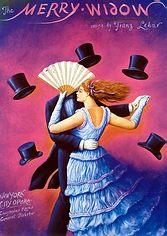
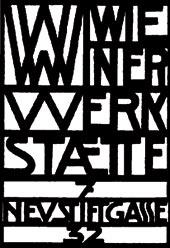
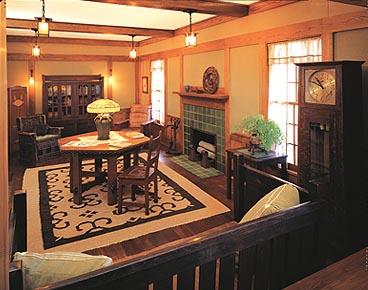
This event will be a treat. In 1905, Viennese composer Franz Lehár wrote the operetta The Merry Widow, the light-as-air story of a seductive widow and her romantic entanglements in upper class Austrian society. But this gilded era in Vienna would soon evaporate with the start of World War I, Sigmund Freud’s dark theories of human nature, and a new avant-garde art movement known as the Secession, inspired by the Arts and Crafts Movement in Great Britain. As Lehar composed The Merry Widow, a group of artists formed the Wiener Werkstätte (Vienna Workshops), an incubator for more modern ideas about art.

You may not be able to go to Café Sperl in Vienna, where Secession members such as Josef Hoffmann and Koloman Moser met for coffee while Lehár composed his fluffy operettas in the corner. But Thursday you can do the next best thing. Enjoy a look at art objects that represented this radical trend in Viennese culture at this transitional moment in history. Afterward, experience musical excerpts from The Merry Widow, juxtaposed with samples of the ultramodern Viennese music that soon succeeded it—all performed by the Indianapolis Opera. IMA’s great exhibit plus Lehár plus Berg, Schonberg, Webern? It gets no cooler than this.

If you like this, you have to attend full performances of The Merry Widow are November 18 & 20 at Clowes Memorial Hall. As part of Spirit & Place, on November 10 I will engage members of the Opera Ensemble in an even darker discussion of how Fin-de-Siècle Vienna provides the political and social context of Lehár’s frothy opera.

Presented by the Indianapolis Opera and the IMA Education Division. Note: While IMA general admission is free that night, there will be a charge to enter the gallery where the Arts & Crafts show and the Music of Art program will take place: the cost is $7 for the public, $5 for IMA members. For more information, contact Patty Harvey at the Opera.

Oct 27: Presidential Elections in Liberia -- what happens next?

A discussion of the most important election in Africa with leading Liberian political scientist Ellwood Dunn

When: Thursday 27 October 2:00-3:30 PM
Where: Sagamore Institute for Policy Research, Third Floor Conference Room 340 West Michigan Street Indianapolis (Historic Landmarks Building)

In August, Ellen Johnson-Sirleaf of Liberia mesmerized a crowd at Sagamore Institute with her insightful analysis of the challenges facing her war-ravaged country as it approached presidential elections scheduled for October. Last week Ms Johnson-Sirleaf finished second in a field of 22 candidates with about 20% of the vote. The leading vote-winner, soccer star George Weah, received about 30%. Since no candidate got more than 50% of the vote, a second run-off election between Johnson-Sirleaf and Weah is scheduled for November 8. The campaign has been intense, and Liberians and their neighbors are watching anxiously to see who wins and whether democracy can put Liberia on the road to recovery.

Helping us understand this very important situation will be one of this country’s leading experts on Liberian politics, Prof. Elwood Dunn of the University of the South in Sewanee, TN. After receiving his PhD from American University and teaching at Fordham University and Seton Hall in the 1970s, Prof. Dunn returned to his native Liberia to teach and serve in government as Minister of State for Presidential Affairs. Author of many books and articles about ethnic conflict and economic development in Liberia and Africa, and frequent guest on PBS and CNN, Prof. Dunn is an ideal guide to making sense of a vital country at a most critical moment.

If you like this event, you should check out ...

Oct. 28: Invest More, Expect More: The Civic Dimension of Immigration Reform


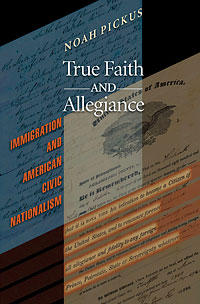
A discussion of local aspects of immigration reform with Noah Pickus, Associate Director of the Kenan Institute for Ethics at Duke University and author of the critically acclaimed new book,
True Faith and Allegiance: Immigration and American Civic Nationalism

When: Friday 28 October 9:00-10:30 AM
Where: IUPUI Informatics Building, Room 167 (535 West Michigan St. Indianapolis)

Few issues today are stirring more fear and controversy than immigration. More people are flooding into the country from more parts of the world than ever before. Who should be allowed in, and under what conditions? How many should be allowed to become US citizens, and what should we expect of them? What should be done with undocumented or illegal aliens who wish to remain here? What will happen if the newcomers cannot be assimilated into American political and social culture? Is it possible that in the process of absorbing people from so many different religions and cultures, we will lose sight of what it means to be "an American"?

The best book about these questions that I've read in years is True Faith and Allegiance: Immigration and American Civic Nationalism, by Noah Pickus of Duke University. Noah offers a view of assimilation and accommodation of newcomers that is at the same time very new (it is unlike the views that are too often shouted shrilly on TV) and very old (it was the view of James Madison and other founders of the country). He argues that we should expect much more of our immigrants, but that we have an obligation to help them meet these expectations. True Faith and Allegiance: Immigration and American Civic Nationalism provocatively argues for a renewed civic nationalism melding principles and peoplehood, a return to a tradition that held sway at the country’s founding and during the Progressive Era. His book takes us through controversies over citizenship for blacks and the rights of aliens at the nation's founding, and examines the interplay of ideas and institutions in the Americanization movement in the 1910s and 1920s. It shows how for the past few decades both Left and Right have promoted a policy of neglect toward immigrants and toward citizenship.

Anxiety about immigration and citizenship is not only fueled by grainy television pictures of people sneaking across the border with Mexico, or by rhetoric from Lou Dobbs. For many people, what is happening (and what they imagine is happening) at home, in their neighborhoods and schools matters even more. Some in Central Indiana aren’t just worried about newcomers “becoming Americans” … they are worried about whether they will become Hoosiers, whether newcomers will embrace local values and integrate into local institutions.

Friday, October 27 at 9:00 AM Noah Pickus will join us to discuss what his idea of civic nationalism means for immigration and Indiana. We are very fortunate to be able to pick the brain of someone with Noah Pickus's experiences and insights, and he may be surprised by what is being achieved here in Indianapolis. I hope this starts a conversation here in Central Indiana that continues long after Prof. Pickus goes back to North Carolina.

This discussion will NOT take place at Sagamore Institute, but will take place in IUPUI's new School of Informatics, room 167. Informatics is located at 535 W Michigan St, at the southwest corner of West and Michigan. Unless you have an IUPUI parking pass, I would recommend you park in the gravel parking lot in front of the Historic Landmarks Building at 340 W Michigan. The Informatics School is a two minute walk from the parking lot.

This event is sponsored by Sagamore Institute and the IUPUI Department of Political Science.

If you like this event, you should check out ...

The discussion on Moving and Staying in a Global Indy at Marian College Nov. 9; and the discussion of Maintaining Religious Values in a Changing Society on Nov. 3.

To see Noah Pickus's philosophy in action, you really should witness the naturalization ceremony at International Festival. Nov. 4 at 3:00 PM the Main Stage at the International Festival transforms into a US District Courtroom where over 150 immigrants will receive the Oath of Allegiance and begin their separate journeys as United States citizens. Join these new citizens and others at the annual International Festival (Nov. 4-6) to celebrate the cultural contributions made by immigrant populations who put their distinctive ethnic stamps on our Hoosier heritage.

Nov 14: The United States and the United Nations -- Who should be reforming whom?

A panel discussion of the advantages and disadvantages of UN reform

When: Monday 14 November 7:30 PM

Where: University of Iindianapolis Recital Hall (105 Goode Hall)

This is part of the important "People Speaks" series. I'll be there, if necessary defending the Bush Administration and John Bolton ... it is sometimes hard to get a genuinely diverse exchange of ideas going in debates these days on college campuses, where so many people start and finish with the argument that the Administration has slushed US foreign policy down the toilet. It's important to recognize that in this unipolar world, no meaningful reform will be adopted without the approval of the US; and no American president Democrat or Republican wants to be accused of sacrificing American sovereignty without getting something VERY substantial in return. This deserves a serious discussion, and it should receive it at the University of Indianapolis where people are serious.

Nov. 15: Amb. Donald Gregg on Korea

This is a chance to hear about the problems of North Korea from one of the world's leading authorities, former Amb. Donald Gregg. Gregg was US Amb to South Korea under Bush I, from 1989-93. Since then he has been chairman of the Korea Society.

When: Tuesday 15 November Refreshments 5:45 PM; Korean Dinner 6:30 PM; talk 7:30 PM

Where: Woodstock Country Club

The Indianapolis Committee on Foreign Relations is sponsoring Gregg's talk. To RSVP contact Courtenay Weldon at courtenayweldon@comcast.net. More details will be posted as they take shape.

More on Gregg:


Gregg has a long and distinguished background in Asian policy affairs that spans more than 50 years. Currently the chairman of the board of the New York
City-based Korea Society, a nonpartisan group that promotes understanding between the United States and Korea, he recently visited North Korea twice as a
private citizen, met with government officials there and gave advice directly to the White House. He also keeps in touch with officials, business people and scholars in Washington, Seoul and Tokyo.

Gregg entered public service in 1951. Following his graduation from Williams College, he joined the Central Intelligence Agency (CIA) and, over the next quarter century, was assigned to Japan, Burma, Vietnam and Korea. He was decorated by the Korean government in 1975. In 1979 Gregg was seconded to the National Security Council staff, where he was in charge of intelligence activities and Asian policy affairs.

In 1982, Gregg was asked by then-Vice President Bush to become his national security adviser. He retired from the CIA, receiving its highest decoration, the Distinguished Intelligence Medal, and served as national security adviser for six years. During his six years with Vice President Bush, Gregg traveled to 65 countries, including Korea.

Between 1980 and 1989, Gregg also served as a professorial lecturer at Georgetown University, where he taught a graduate level workshop titled "Force and Diplomacy" to students in the Master of Science in Foreign Service program.

In September 1989, Gregg was appointed ambassador to Korea by then-President Bush and served in that position for the next three-and-a-half years. Prior to his departure from Korea in 1993, he received the U.S. Department of Defense Medal for Distinguished Public Service, an honorary degree from Sogang University, and a decoration from the Prime Minister of Korea. In March 1993, Gregg retired from a 43-year career in the United States government and assumed his current position with the Korea Society. He is a member of the Council on Foreign Relations. Recent awards he has received include an honorary degree from Green Mountain College (1996), the Secretary of Defense Medal for Outstanding Public Service (2001) and Williams College's Kellogg Award for career achievement (2001).


Oct. 15: Mr Harry Belafonte on civil rights at the Diversity Summit

A talk by one of the giants of the past half century

When: Saturday 15 October 12:45-1:45 PM

Where: Madame Walker Theatre Center 617 Indiana Avenue, Indianapolis, IN. 46202

October 14 and 15 the Indiana Supreme Court's Commission on Race and Gender Fairness is holding a Diversity Summit 2005 in order "to unite citizens, lawyers, judges and public safety officers, promoting an understanding and awareness that inclusiveness and diversity are valued in the legal profession and emphasizing that fairness and understanding of gender, race, and ethnicity issues are required in the justice system. Topics to be covered include prosecutorial discretion, jury trends, recruiting and retaining minority law enforcement officers, improving diversity in legal education, legal issues in the international community, the business case for diversity, juvenile ethnic gangs, social consciousness issues regarding sexual orientation, and urban vs. rural sentencing." All very worthy, important topics, to learn more go here.

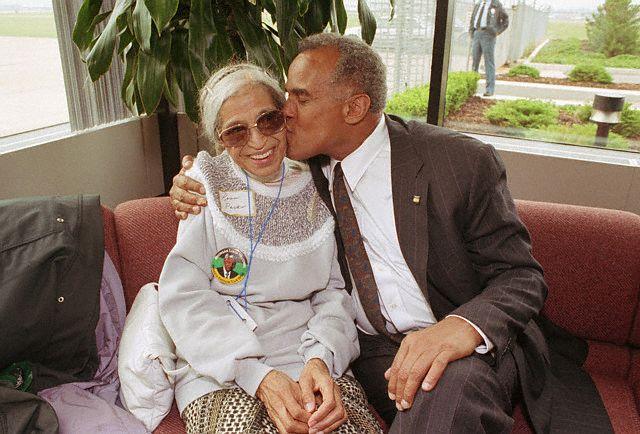
But what makes the Diversity Summit special is the Saturday keynote speaker, Mr. Harry Belafonte. There may be Americans greater than Belafonte, but none are leaping to my mind right now. I'll pass without comment his career as film star, singer, entertainer. It is his work for civil rights in the US and human rights around the world that is most important. Belafonte donated the money for bail releasing Martin Luther King Jr from the Birmingham jail in 1963. He came up with the idea of bringing together musicians in the 1980s for the "We Are the World" series that raised millions of dollars for Ethiopian famine relief. Belafonte's was a leading voice supporting Nelson Mandela during his years of imprisonment. He has even kissed Rosa Parks.

And he is coming to the gorgeous Madame Walker Theatre October 15. What could be better?

Well the answer might be to attend the Indiana Civil Liberties Union conference that same day (October 15), and head over to Madame Walker to hear Belafonte talk, then go back to the ICLU conference. That's possible thanks to the Commission on Race and Gender Fairness, which has very generously invited ICLU Conference attendees to hear Belafonte. The cost and transportation of attending this event is included in the price of the ICLU conference registration.

You can go here to learn more about the Diversity Summit agenda and registration. It will cost $25 only to attend Belafonte's talk, so if you are a student it will be cheaper to register for the ICLU conference alone ($10). No matter how you attend, it should be a buzzworthy experience.

Art Farnsley's talk: what he said to the Mid-North Shepherd's Center

"Provocative moderation," that was the stance Art Farnsley laid out in his talk to the Mid-North Shepherd's Center. I'll try more often to provide reviews or summaries or (as in this case) the content of events around town. Read Art's talk here, it is a great one. Some day soon the American Values Alliance will emerge fully formed into the world, if this first speech by executive director Art Farnsley is any indication, we can expect great things. I strongly recommend attending his book talk during Spirit & Place November 9.

Oct. 12: The Real Price of Oil: Human Rights Violations in the Niger Delta


A lecture by Patterson Ogon, Founding Director of the Ijaw Council for Human Rights in Port Harcourt and Yenagoa, Nigeria

When: Wednesday, October 12 4:00-5:00 PM

Where: IUPUI Cavanaugh Hall 438

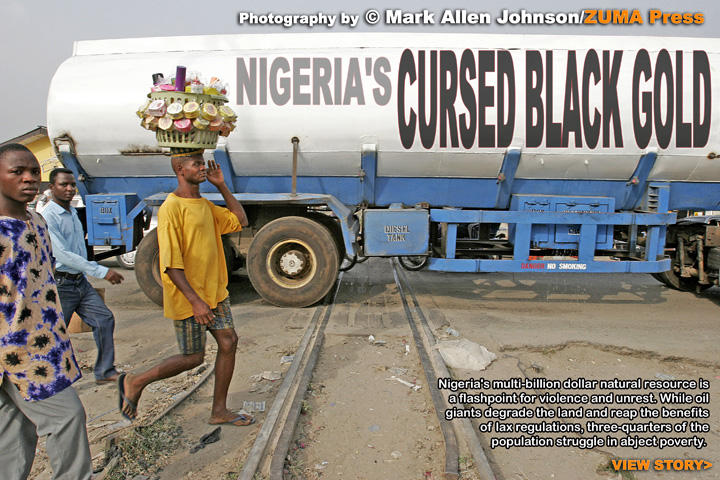
As the price of gasoline has reached historic highs, many Americans have complained about the negative impact that high gas prices have on their personal finances. Residents of many African oil-producing countries, however, ask why they have not received any benefits from such windfall revenues. More than two-thirds of Nigeria’s oil is found in the land of the Ijaw people. Yet, the vast majority of Ijaws have no electricity and no piped drinking water. In December 1998, the Ijaw people set out their demands for self-determination and local control over natural resources in the Kaiama Declaration. The Nigerian state responded to their peaceful demands with a military campaign of repression and sustained human rights violations. The villages of Odi and Odioma were razed, thousands of Ijaws have been killed, and millions were effectively denied their right to vote in Nigeria’s fraudulent 2003 “democratic” elections. This presentation describes the current state of affairs in the oil-producing Niger Delta region, explores corporate and state complicity in human rights violations against the oil-producing communities and argues that the best way forward for Nigeria is through a system of local self government and resource control in a federation of ethnic nationalities.

Patterson Ogon is the Founding Director of the Ijaw Council for Human Rights, (ICHR) a Policy advocacy non-governmental organization in Nigeria’s Niger Delta and is the Associate Director of Our Niger Delta. He has worked on several intervention measures in community conflicts both within and outside of the Niger Delta. A 1990 graduate of Politics and Administration at the University of Port Harcourt, Nigeria, he has been trained in conflict mitigation and peace building both by the United States consulate in Nigeria and other institutions. He has participated in conferences and initiatives both within and outside Nigeria including Bread for the World on “The Challenges of Better Practice in the Oil Industry: Dialogue between European Civil Society Groups and Multinational Oil Corporations”, German based World Economy, Ecology and Development (WEED) initiative on “Strategic Alliances of Northern and Southern NGOs in Global Environmental Policy to strengthen the flow of information in the field of trade and environment. He is currently a Luce Residential Fellow at the University of California Berkeley.

Ogon Patterson's talk is sponsored by the IUPUI African and African American Diaspora Studies Committee and the Department of Political Science. We can thank "Chief of Light" Scott Pegg, who is a frequent and impassioned speaker about the damages wrought on the land and especially the people of Africa by the energy industry. Contact Scott to get involved in doing something to help.

If you like this event, you should check out ... upcoming discussions of Darfur and Randall Tobias's work fighting AIDS in Africa. You also might be interested in my talk about the global politics of water, another intersection of environment and foreign affairs.

Oct. 10: Getting tickets to the Second Coming (of Bill Clinton)


It was a jumbled mess (I am told) getting tickets to Bill Clinton's book signing at the 82nd street Barnes & Noble earlier this year. This year it ought to move smoother as Butler University distributes tickets for Clinton's speech Nov. 6. If you are a member of the Butler faculty or student body, you should have your golden tickets. If you are not, you have one chance. Says the University:


Butler University today announced the policy for obtaining tickets to the upcoming speech by Honored Sesquicentennial Speaker former President William J. Clinton at Hinkle Fieldhouse. Tickets for former President Clinton’s Nov. 6 speech will be made available to the general public at 10 a.m. Oct. 10. Tickets will be distributed at the Clowes Memorial Hall box office. University officials said two tickets would be available per person. The tickets are free. Lines will begin forming at 8 a.m. at the east side entrance to Clowes Hall. Lines formed before 8 a.m. will not be honored. Absolutely no overnight camping will be allowed.
.
I am not sure what the university will do to overnight campers, but I would not recommend testing the matter. Campus police probably have stocks of teargas left over from the Sixties (and kept in a back room just in case Butler ever wins an NCAA championship, which seems to be cause for students to try to burn down their schools). Play it safe, show up at 8:00 Monday with a good book and make friends with other political junkies queuing up with you.

Oct. 7: Trust a politician, go to a Starbuck's and open the doors to local culture


I just heard about this from Keira Amstutz, assistant deputy mayor for cultural development (can there be a sweeter job for a bureaucrat?):

Starbucks Coffee is partnering with the Arts Council of Indianapolis and the Cultural Development Commission to promote the 2005-2006 Indianapolis Cultural calendar. For one day only -- on Friday, Oct. 7 -- anyone who stops for a cup of coffee at one of 45 Central Indiana Starbucks stores will be treated to a complimentary copy of the Cultural Calendar AND a Starbucks card worth $5. The offer is good while supplies last, and there's a limit of one complimentary card and one cultural calendar per customer.

As part of Friday's celebration, local musicians will perform at four Starbucks locations from 8 a.m. to 9 a.m. Performers include guitarist Greg Ziesmer at the Conseco Fieldhouse store, guitarist John Alvarado at the Broad Ripple store, harpist Melissa Gallant at U.S. 31 and Edgewood Road and harpist Jill Pitz at the Carmel store at 116th Street and Keystone Avenue.

Also on Friday, the Indianapolis Downtown Artists & Dealers Association
(IDADA) is holding its First Friday Art Tour, when numerous galleries throughout downtown hold openings. Village Drums will perform at Davlan Park next to the Starbucks in the Mass Ave Cultural District from 7:30 p.m. to 8:30 p.m.

The Indianapolis Cultural Calendar features more than 700 arts and cultural events happening in and around the city during the next 16 months (September 2005-December 2006). Each calendar includes an IndyArts card, which gives users discounts on performances, exhibits and other cultural events across the city. The calendar cover features a vibrant abstract painting by Indianapolis artist Quincy Owens. Valued at $9.50 each, the calendars are for sale at www.indyarts.org or in the stores at The Children's Museum of Indianapolis, Conner Prairie, Eiteljorg Museum of American Indians and Western Art, Indiana History Center, Indiana State Museum, Indianapolis Art Center, Indianapolis Artsgarden and Indianapolis Museum of Art.

What a deal! For the piece of a cup of Starbuck's coffee (yes, I know, it is expensive coffee) you get the cup of coffee, a $9.50 culture calendar, and an IndyArts card ... plus the possibility of live harp music if you go to the right Starbucks. Wow! How could you possibly turn down this offer?

Well, you might feel that you wouldn't recognize a Starbusk's store if you saw one, and thus couldn't find the right place. But go here for pictures of every Starbuck's in Indianapolis ... trust me, you'll recognize one when you see it.

Perhaps you feel that this really is too good an offer to be true, politicians have lied to you in the past, how can you trust this assistant deputy mayor for cultural development? Keira Amstutz clearly is a different breeed of politician, one who is comfortable posing with a double bass, so when she says she has 10,000 calendars to distribute, let's quote Ronald Reagan: "Trust but verify." Go to a Starbuck's Friday and see for yourself.

Maybe you are thinking it isn't worth making the trip to a Starbuck's for an IndyArts card and Indianapolis Cultural Calendar won't be worth it because, well, "Indianapolis Culture" is an oxymoron. The art scene here is kind of provincial, not very edgy or avant-gardey, sort of like harp music in a Starbuck's. You might say that, but if you did you would be very mistaken. As I have said before, the arts and music scene in Indianapolis right now reminds me of how Seattle felt around 1980 when there was clearly a lot of potential bubbling away. For more on this ferment (from people who are a lot more cultured than am I) check out the Spirit & Place discussion of arts and artists gravitating to Indy.

Welcome to IndyBuzz

IndyBuzz provides information about Central Indiana's most stimulating and thought provoking events -- discussions and conferences, art exhibitions, films, music performances. It tells you what's happening … explains why you should be part of what’s happening. More than an events calendar, though, IndyBuzz tries to make events more meaningful for participants by suggesting an article or two to read before the event, recommending books or websites that will be sources of further information after the event, and pointing out related events that are worth attending.

Visit IndyBuzz's sister site, http://www.provocate.org/, which provides a context for the clusters of the events discussed in IndyBuzz.

Who is IndyBuzz?

Provocate strengthens the intellectual and civic fabric of Central Indiana by connecting global & local, entertainment & education, culture & policy